
Since her debut in 1959, Barbie has embarked on hundreds of careers—from astronaut to CEO—yet it took until 2015 for Mattel to introduce a Scientist Barbie.* That delay says a lot about how society still under-invests in encouraging girls and young women toward Science, Technology, Engineering, and Math (STEM) fields.
Barbie herself isn’t the point. What matters is what she represents: the possibility for women to imagine and pursue any path, unconstrained by social norms or expectations. When women are excluded, whether implicitly or explicitly, science loses talent, perspective, and impact. Science thrives on diversity and women are essential for solving global challenges.
Still Too Few Women in STEM But Progress Is Real
Despite gradual improvements, women remain underrepresented in science and research globally. According to new UNESCO 2025 data, 35% of STEM graduates worldwide are women, yet disparities persist in pay, publications, career progression, and leadership. Closing these gaps matters in all fields, but especially for fields at the intersection of health, food systems, environment, and climate.
Women are the backbone of agrifood systems and rural economies, yet they’re still working with one hand tied behind their backs. Access to land, inputs, services, finance, and digital tools remains uneven, and the costs are real. Data from the UN Food and Agriculture Organization’s 2023 State of Women in Agrifood Systems report makes this all too clear. Structural employment barriers depress productivity and lock in wage gaps.
Closing this gender gap isn’t just fair, it’s smart economics, according to the same FAO report. Global GDP would rise by about 1 percent, which is nearly USD 1 trillion. One percent may sound small, but it would reduce food insecurity by 2 percent, lifting roughly 45 million people out of hunger. And the irony is that women—who produce much of the world’s food—are more likely to go hungry themselves: Between 2019 and 2021, the food insecurity gap between women and men more than doubled from 1.7 percent to 4.3 percent.
This is why the United Nations General Assembly in 2015 declared 11 February the International Day of Women and Girls in Science to remind us why we must keep pushing. Representation matters at every level, from classrooms to scientific world stages.
Today, Women Are Leading CGIAR Science
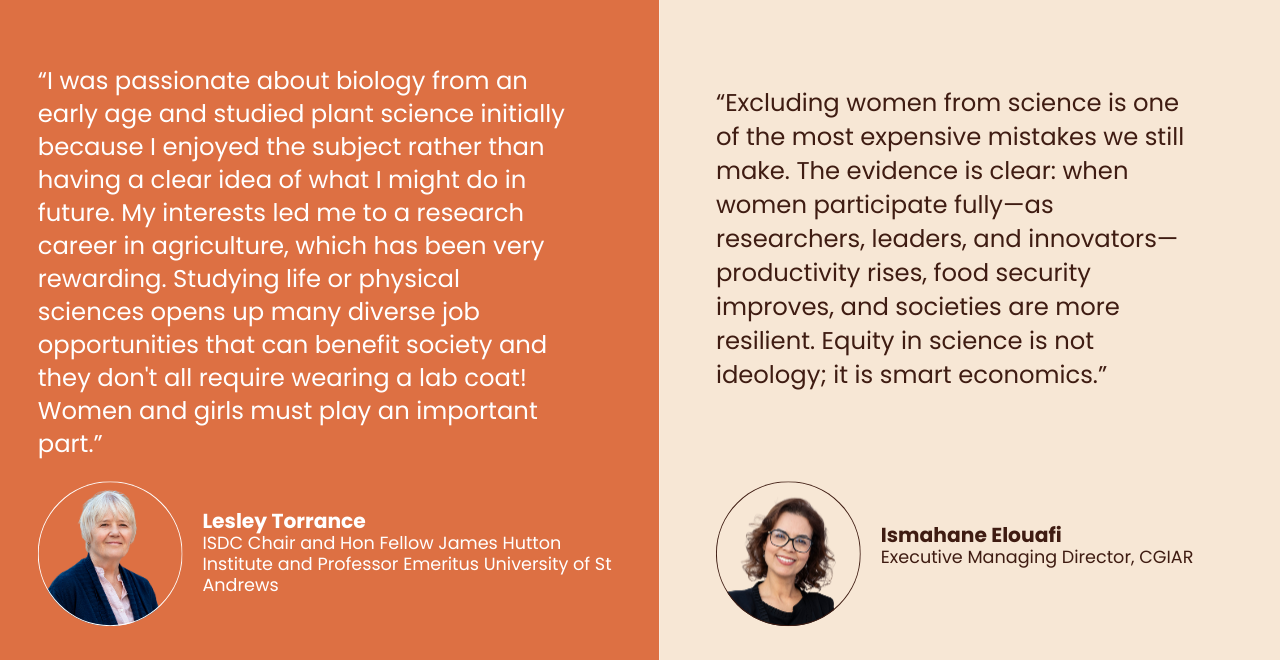
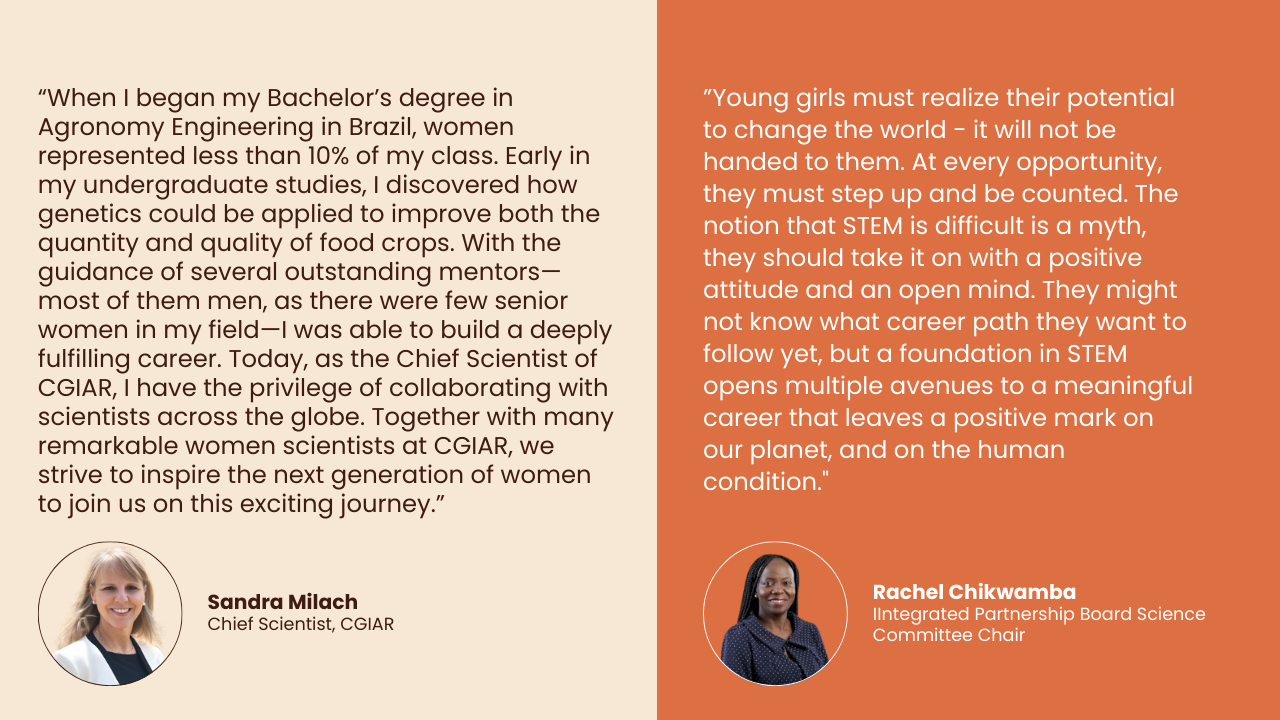
At CGIAR, women are shaping scientific direction from the highest levels, including:
- Independent Science for Development Council Chair Lesley Torrance
- Executive Managing Director Ismahane Elouafi
- Chief Scientist Sandra Cristina Kothe Milach
- Integrated Partnership Board Science Committee Chair Rachel Chikwamba
That leadership is reinforced across the Independent Advisory and Evaluation Service. Women make up 63 percent of ISDC and 67 percent of the International Standing Panel of Assessment (SPIA). This isn’t symbolic representation; it’s concrete evidence that gender diversity belongs at the center of decisions shaping global research agendas.
Real change happens when women reach the top of science systems:
- They shape research priorities that address real needs, from climate resilience to nutrition and gender equity
- They model success for the next generation, showing girls and young women that leadership in science is attainable
- They expand who gets to ask questions, define problems, and design solutions, which are core ingredients for effective science
What Scientist Barbie Should Inspire
Despite progress in leadership, broader structural obstacles remain with biases in hiring and funding, uneven mentorship opportunities, and social norms that still steer girls away from STEM pathways.
Loved by some and questioned by others, Barbie’s mix of tradition and progress is still debated. Scientist Barbie, however, is more than a doll in a lab coat. She represents:
- Girls seeing science as a welcoming career
- Girls visualizing themselves by donning lab coats—even though science doesn’t have a dress code
- Women leading the research that shapes agriculture, health, climate, and technology, and other domains
- Institutions making gender equity a core measure of success
CGIAR’s leadership landscape in 2026 shows that the world is changing for the better. And that’s the kind of progress worth celebrating. As we mark the International Day of Women and Girls in Science, let’s work with these leaders to turn the day’s aspirations into tangible progress and learn from their experiences in paving the way for future women scientists.
* Note that many of the more than 250 careers Barbie has had since her creation in 1959 had science at their core (e.g., paleontologist in 1995), but “Scientist Barbie” launched in 2015. In 2016 Mattel released “Farmer Barbie,” which was science-based with the packaging including: “Many farmers study agriculture in college. They learn all kinds of things like dairy science, animal science, and agricultural economics.”
**This blog was inspired by a 2024 blog Science Needs Women—Go Ask Barbie!