
Main menu

  • Home
  • About
  • Who we are
  • News
  • Events
  • Publications
  • Search

Secondary Menu

  • Independent Science for Development CouncilISDC
    • Home
    • Who we are
    • News
    • Events
    • Publications
    • Featured Projects
      • Inclusive Innovation
        • Agricultural Systems Special Issue
      • Proposal Reviews
        • 2025-30 Portfolio
        • Reform Advice
      • Foresight & Trade-Offs
        • Megatrends
      • QoR4D
      • Comparative Advantage
  • Standing Panel on Impact AssessmentSPIA
    • About
      • Who we are
      • Our Mandate
      • Impact Assessment Focal Points
      • SPIA Affiliates Network
    • Our Work
      • Country Studies
        • Community of Practice
        • Bangladesh Study
        • Ethiopia Study
        • Uganda Study
        • Vietnam Study
      • Causal Impact Assessment
      • Use of Evidence
      • Cross-Cutting Areas
        • Capacity Strengthening
        • Methods and Measurement
        • Guidance to IDTs
    • Resources
      • Publications
      • Blog Series on Qualitative Methods for Impact Assessment
      • SPIA-emLab Agricultural Interventions Database
    • Activities
      • News
      • Events
      • Webinars
  • Evaluation
    • Who we are
    • News
    • Events
    • Publications
    • Evaluations
      • Science Group Evaluations
      • Learning on CGIAR's Ways of Working
      • Platform Evaluations
        • CGIAR Genebank Platform Evaluation
        • CGIAR GENDER Platform Evaluation
        • CGIAR Excellence in Breeding Platform
        • CGIAR Platform for Big Data in Agriculture
    • Framework and Policy
      • Evaluative Learning Hub
      • Evaluation Method Notes Resource Hub
      • Management Engagement and Response Resource Hub
      • Evaluating Quality of Science for Sustainable Development
      • Evaluability Assessments – Enhancing Pathway to Impact
      • Evaluation Guidelines
  • Independent Science for Development CouncilISDC
  • Standing Panel on Impact AssessmentSPIA
  • Evaluation
Back to IAES Main Menu

Secondary Menu

  • Home
  • Who we are
  • News
  • Events
  • Publications
  • Featured Projects
    • Inclusive Innovation
      • Agricultural Systems Special Issue
    • Proposal Reviews
      • 2025-30 Portfolio
      • Reform Advice
    • Foresight & Trade-Offs
      • Megatrends
    • QoR4D
    • Comparative Advantage
Tanmoy Bhaduri/IWMI
Blog

Tools to Support Consistent, Transparent, and Future-ready CGIAR Prioritization Decisions

You are here

  • Home
  • Independent Science for Development CouncilISDC
  • News
  • Tools to Support Consistent, Transparent, and Future-ready CGIAR Prioritization Decisions

With shrinking resources and growing global challenges, prioritization is more than a catchphrase; it is a survival strategy. For CGIAR, prioritization, i.e. the process of systematically identifying and ranking research investments based on their strategic alignment, impact, and feasibility to achieve desired goals, is complex and often contentious. Multiple stakeholders, diverse interests, minimal budget flexibility and tough trade-offs make this a high-stakes exercise. So how can we support CGIAR to make prioritization decisions more consistent, transparent, and future-ready?

This is why the Independent Science for Development Council (ISDC) created the new Brief Primer on Tools to Prioritize a Research and Innovation Portfolio in a Complex System Involving Multiple Decision Makers. The aim is to equip CGIAR scientists, management, and the Independent Partnership Board (IPB) with practical tools for prioritization. This isn’t about compliance or revisiting past decisions; it is a toolkit for future prioritization exercises.

Why This Matters

CGIAR operates in a complex environment with multiple decision makers and competing priorities. Funders must have confidence that their contributions align with CGIAR’s mission and strategic goals, as well as their own. Transparent prioritization builds that confidence and strengthens coherence across the entire Portfolio.

The Primer offers a structured yet flexible approach to help answer critical questions such as:

  • Which areas of work should CGIAR protect or phase out?
  • Where do we have the greatest comparative and absolute advantages?
  • How do we balance short-term needs with long-term objectives?

What’s Inside

The Primer is a brief, practical guide to tools and approaches that make prioritization more objective and repeatable. Highlights include:

  • Systems Perspective: Recognizes the complexity and interlinkages across the Portfolio; priority setting should not be entirely retrospective nor prospective. Trade-offs across priorities are expected and must be managed.
  • Top-Down and Bottom-Up Approaches: Combine Portfolio-level cohesion with program-level insights.
  • Key Tools:
    • Strategy alignment and theory of change
    • Comparative and absolute advantage analyses
    • Boundary setting for clarity on “where CGIAR plays”
    • Defining indicators that link global targets to areas of strength
    • Foresight and trade-off analyses

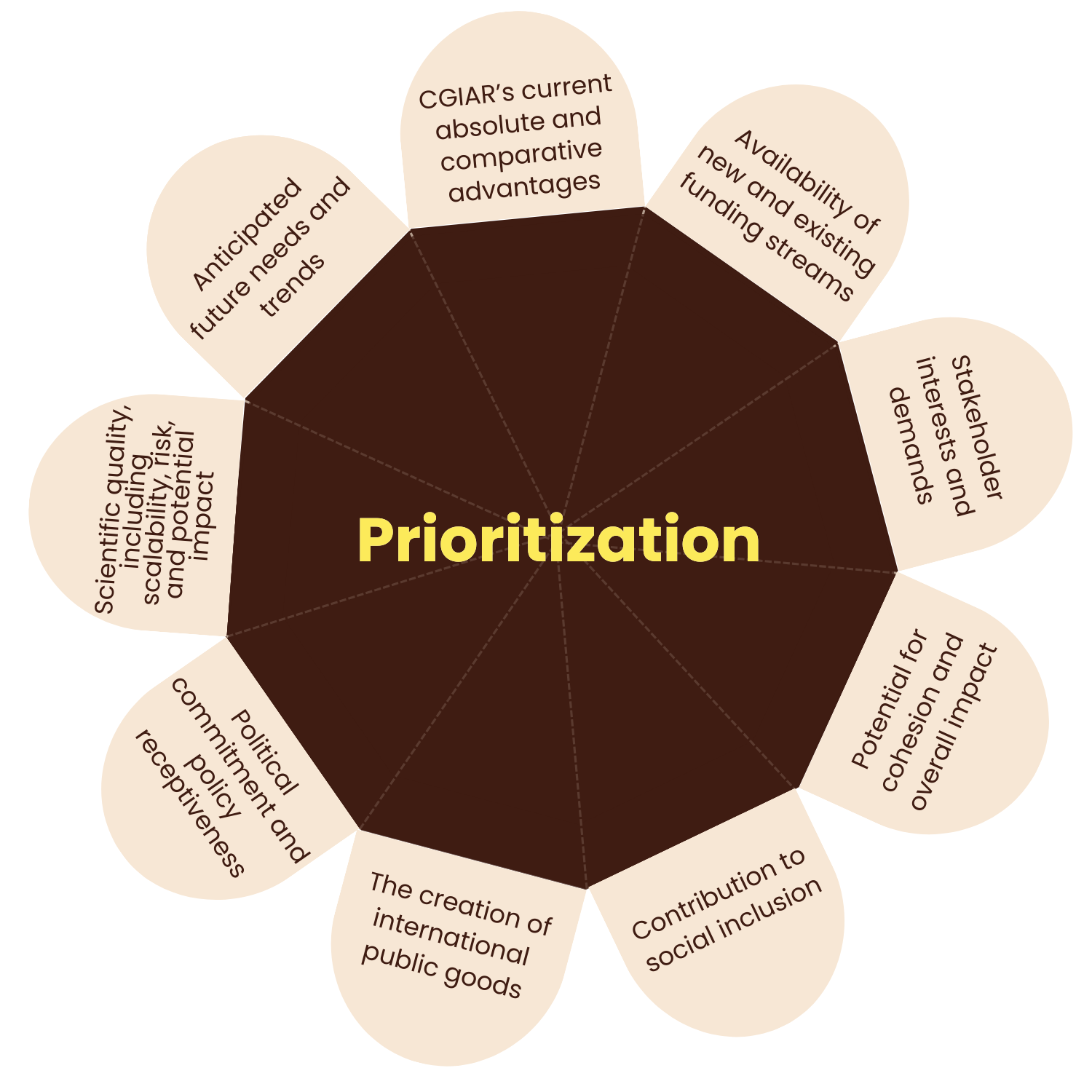
These tools aren’t prescriptive; they are adaptable and serve various purposes. The purpose of these tools is to strengthen decision making, not to constrain it. The following diagram outlines some of the key considerations to which these tools can be applied.
Looking Ahead

Prioritization is not a one-off activity. It is an ongoing process that needs to evolve with shifting global realities such as climate change, geopolitical shocks, emerging technologies, and funding pressures and opportunities. By applying the approaches highlighted in this Primer, CGIAR can make tough, transparent choices with confidence, ensuring that limited resources deliver maximum impact across the entire Portfolio.

This is not the final word on prioritization. As the CGIAR evolves and embeds prioritization into its practices, additional methods might be added to this toolkit. Achieving this will require ongoing dialogue, constructive feedback and strong collaboration. 

 

Read the Primer 

Share on

Science ISDC
Jan 26, 2026

Written by

  • Erin Lentz

    ISDC Member
  • Holger Meinke

    ISDC Chair 2019-2025

Related Publications

Strategic & Synthesis Studies
Science ISDC
Issued on 2025

Brief Primer on Tools to Prioritize a Research and Innovation Portfolio in a Complex System Involving Multiple Decision Makers

ISDC review cover page
Assessments & Commentaries
Science ISDC
Issued on 2025

ISDC Review of 2025-2030 Research and Innovation Inception Reports

Assessments & Commentaries
Science ISDC
Issued on 2024

ISDC Feedback on CGIAR Portfolio Narrative 2025-2030

More publications

CGIAR Independent Advisory and Evaluation Service (IAES)

Alliance of Bioversity International and CIAT
Via di San Domenico,1
00153 Rome, Italy
  • IAES@cgiar.org
  • (39-06) 61181

Follow Us

  • LinkedIn
  • Twitter
  • YouTube
JOIN OUR MAILING LIST
  • Terms and conditions
  • © CGIAR 2026

IAES provides operational support as the secretariat for the Independent Science for Development Council and the Standing Panel on Impact Assessment, and implements CGIAR’s multi-year, independent evaluation plan as approved by the CGIAR’s System Council.