SPIA Country Studies Community of Practice Webinar Series
Webinar 1: Introduction to SPIA Country Studies Community of Practice
This introductory webinar navigates the SPIA Affiliates Network, the current portfolio including the status of SPIA-run studies in Ethiopia, Vietnam, Uganda and Bangladesh, an introduction from the SPIA's advisory team, followed by introductions from each team, and an introduction to the main communication tool, ASANA, used now by the Community of Practice.
Webinar 2: Implementing the Stocktaking process at the Country Level
The second session of the Country Studies Webinar Series focused on Stocktaking—an essential step to trace CGIAR-related innovations and policy contributions from research to real-world impact. Using the Viet Nam experience, Frédéric Kosmowski walked participants through the process of identifying innovations and addressing knowledge gaps, highlighting practical steps and tools.
Webinar 3: Remote Sensing: Guidelines and Community of Practice
The third session of the Country Studies Webinar Series focused on the use of Remote Sensing (RS) for impact evaluation. Jennifer Burney and Paula Paz shared insights from 11 CGIAR-funded case studies, exploring how Earth Observation (EO) data can be used to assess innovation outcomes when direct measurements aren’t available. The session also included a brief introduction to the RS guideline book (with a download link), a summary of the Ethiopia case study, and a discussion on the Community of Practice (CoP) for RS.
Webinar 4: DNA Fingerprinting & Bioinformatics
The fourth session of the Country Studies Webinar Series introduced DNA Fingerprinting as a powerful tool for improving the accuracy of variety identification in adoption studies. Davis Gimode explained key concepts—like genotype, phenotype, and fingerprinting—and highlighted the limitations of relying on farmer self-reports. With falling costs of genome-scale data, DNA fingerprinting is becoming a reliable and scalable method for adoption tracking. The session also walked through the full process: from building a reference library and collecting samples to genotyping and analysis.
Webinar 5: Data Management and Quality Control Norms
This webinar explores Data Management & Quality Control Norms with Kyle Emerick. Drawing on lessons from Uganda and Bangladesh, the webinar highlighted essential steps for ensuring data accuracy—from field supervision and audio audits to high-frequency checks. We also walked through the full data journey: from cleaning and merging to replication-ready analysis. Finally, the session covered open access timelines and best practices for sharing data and code.
Webinar 6: Gender in the SPIA Country Studies
After the five introductory webinars exploring the main aspects, methods, and instruments used during the first phase of the Country Studies, our Community of Practice continued the work of expanding the knowledge, and showing cases where stocktaking, fingerprinting, remote sensing and data management practices are implemented.
This webinar explored options for integration to better understand the role of women in agri-food systems. Presented by Hazel Malapit from IFPRI and Diana Lopez-Avila, Senior Scientist in Gender and Impact Assessment from the CGIAR GENDER Impact Platform.
Webinar 7: 2nd Webinar on Remote Sensing
The seventh session of these webinars highlighted the use of Remote Sensing methods in Viet Nam. David Wüpper, from the Land Economics Group at the Institute for Food and Resources at the University of Bonn, discussed the opportunities and challenges of their application. Additionally, Jeffrey Michler and Beth Tell, both from the University of Arizona, presented the case of stress-tolerant rice varieties in Bangladesh, illustrating impact evaluations in data-poor settings.
Webinar 8: 2nd Webinar on DNA Fingerprinting
The second webinar on DNA Fingerprinting featured James Stevenson, SPIA Senior Research Fellow, Frederic Kosmowski, SPIA Senior Scientist, and Davis Gimode, SPIA Bioinformatics Research Specialist. They led an engaging discussion on new guidance for reference compilation, field sampling, and survey integration. The talk also covered key players in national seed systems, building reference libraries, field sampling considerations, and connecting samples to surveys.
Webinar 9: Knowledge, accuracy and precision in adoption studies relying on DNA fingerprinting
Held just a week after the second webinar on DNA fingerprinting, this webinar highlighted the adoption of these practices with a focus on knowledge, accuracy, and precision. Led by Martina Occelli, Principal Investigator, SPIA Research Associate in Agricultural Economics at Cornell University, and Associate Director of the Feed the Future Innovation Lab for Crop Improvement, the session covered Varietal Knowledge and Genomic Uncertainty in Adoption Studies using DNA fingerprinting. It emphasized nuanced considerations in designing survey-fingerprinting protocols and featured work led by INTA (Costa Rica) involving a team of geneticists, breeders, and agricultural economists.
Webinar 10: Learning About How Things Work — Process Tracing Methods
We're always pleased to report the positive impacts of CGIAR innovations — but understanding how that impact was made is important for ensuring that it can be reproduced and scaled. Process tracing is an in-depth case study message used to understand these "hows" by:
1. Empirically tracing process(es) that produced a contribution (how things worked)
2. Studying how context shapes how things work (enabling/supporting factors)
3. Understanding why intervention did NOT work (deviant cases)
4. Producing theories that can be used for policy design and strategic planning of interventions
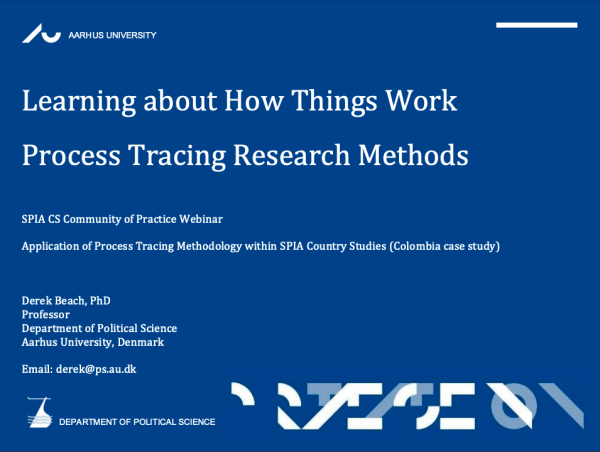
In this webinar, Derek Beach (SPIA Co-PI, Professor, Department of Political Science, Aarhus University) presented the basics of process tracing, as well as preliminary results in the context of the SPIA Colombia Country Study. The research was carried out in collaboration with Gabriela Camacho Garland, Research Coordinator, Transparency International.