  • Home
  • About
  • Who we are
  • News
  • Events
  • Publications
  • Search
  • Independent Science for Development CouncilISDC
    • Home
    • Who we are
    • News
    • Events
    • Publications
    • Featured Projects
      • Inclusive Innovation
        • Agricultural Systems Special Issue
      • Proposal Reviews
        • 2025-30 Portfolio
        • Reform Advice
      • Foresight & Trade-Offs
        • Megatrends
      • QoR4D
      • Comparative Advantage
  • Standing Panel on Impact AssessmentSPIA
    • Who We Are
      • SPIA Team
      • Our Mandate
      • Impact Assessment Focal Points
      • SPIA Affiliates Network
    • What We Do
      • Country Studies
        • Community of Practice
      • Causal Impact Assessment
      • Use of Evidence
    • Where We Work
      • Bangladesh Study
      • Ethiopia Study
      • Uganda Study
      • Vietnam Study
    • Resources
      • Publications
      • Events
      • SPIA-emLab Agricultural Interventions Database
      • News & Blogs
        • Blog Series on Qualitative Methods for Impact Assessment
      • Webinars
  • Evaluation
    • Who we are
    • News
    • Events
    • Publications
    • Evaluations
      • Science Group Evaluations
      • Learning on CGIAR's Ways of Working
      • Platform Evaluations
        • CGIAR Genebank Platform Evaluation
        • CGIAR GENDER Platform Evaluation
        • CGIAR Excellence in Breeding Platform
        • CGIAR Platform for Big Data in Agriculture
    • Framework and Policy
      • Evaluative Learning Hub
      • Evaluation Method Notes Resource Hub
      • Management Engagement and Response Resource Hub
      • Evaluating Quality of Science for Sustainable Development
      • Evaluability Assessments – Enhancing Pathway to Impact
      • Evaluation Guidelines
  • Independent Science for Development CouncilISDC
  • Standing Panel on Impact AssessmentSPIA
  • Evaluation
Back to IAES Main Menu
  • Who We Are
    • SPIA Team
    • Our Mandate
    • Impact Assessment Focal Points
    • SPIA Affiliates Network
  • What We Do
    • Country Studies
      • Community of Practice
    • Causal Impact Assessment
    • Use of Evidence
  • Where We Work
    • Bangladesh Study
    • Ethiopia Study
    • Uganda Study
    • Vietnam Study
  • Resources
    • Publications
    • Events
    • SPIA-emLab Agricultural Interventions Database
    • News & Blogs
      • Blog Series on Qualitative Methods for Impact Assessment
    • Webinars
Feb 12, 2025

SPIA Country Studies Community of Practice - Webinar 3: Remote Sensing - Guidelines and Community of Practice

You are here

  • Home
  • Standing Panel on Impact AssessmentSPIA
  • Webinars
  • SPIA Country Studies Community of Practice - Webinar 3: Remote Sensing - Guidelines and Community of Practice

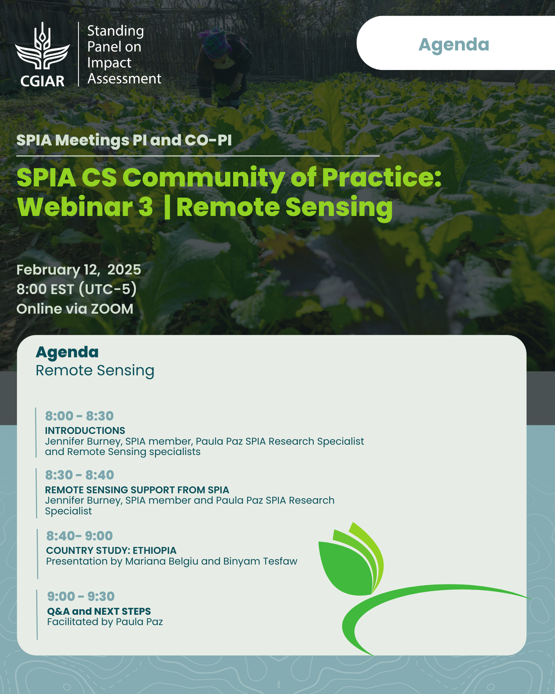
The third session of the Country Studies Webinar Series focused on the use of Remote Sensing (RS) for impact evaluation. Jennifer Burney and Paula Paz shared insights from 11 CGIAR-funded case studies, exploring how Earth Observation (EO) data can be used to assess innovation outcomes when direct measurements aren’t available. The session also included a brief introduction to the RS guideline book (with a download link), a summary of the Ethiopia case study, and a discussion on the Community of Practice (CoP) for RS.
rs

Leave us your thoughts, questions and feedback here 

Facilitator(s)

  • Jennifer Burney

    SPIA Member
  • Paula Paz Garcia

    Remote Sensing Specialist, SPIA Country Studies

Presentation(s)

  • Webinar3 CoP Remote Sensing (2).pdf

CGIAR Independent Advisory and Evaluation Service (IAES)

Alliance of Bioversity International and CIAT
Via di San Domenico,1
00153 Rome, Italy
  • IAES@cgiar.org
  • (39-06) 61181

Follow Us

  • LinkedIn
  • Twitter
  • YouTube
JOIN OUR MAILING LIST
  • Terms and conditions
  • © CGIAR 2026

IAES provides operational support as the secretariat for the Independent Science for Development Council and the Standing Panel on Impact Assessment, and implements CGIAR’s multi-year, independent evaluation plan as approved by the CGIAR’s System Council.