  • Home
  • About
  • Who we are
  • News
  • Events
  • Publications
  • Search
  • Independent Science for Development CouncilISDC
    • Home
    • Who we are
    • News
    • Events
    • Publications
    • Featured Projects
      • Inclusive Innovation
        • Agricultural Systems Special Issue
      • Proposal Reviews
        • 2025-30 Portfolio
        • Reform Advice
      • Foresight & Trade-Offs
        • Megatrends
      • QoR4D
      • Comparative Advantage
  • Standing Panel on Impact AssessmentSPIA
    • Who We Are
      • SPIA Team
      • Our Mandate
      • Impact Assessment Focal Points
      • SPIA Affiliates Network
    • What We Do
      • Country Studies
        • Community of Practice
      • Causal Impact Assessment
      • Use of Evidence
    • Where We Work
      • Bangladesh Study
      • Ethiopia Study
      • Uganda Study
      • Vietnam Study
    • Resources
      • Publications
      • Events
      • SPIA-emLab Agricultural Interventions Database
      • News & Blogs
        • Blog Series on Qualitative Methods for Impact Assessment
      • Webinars
  • Evaluation
    • Who we are
    • News
    • Events
    • Publications
    • Evaluations
      • Science Group Evaluations
      • Learning on CGIAR's Ways of Working
      • Platform Evaluations
        • CGIAR Genebank Platform Evaluation
        • CGIAR GENDER Platform Evaluation
        • CGIAR Excellence in Breeding Platform
        • CGIAR Platform for Big Data in Agriculture
    • Framework and Policy
      • Evaluative Learning Hub
      • Evaluation Method Notes Resource Hub
      • Management Engagement and Response Resource Hub
      • Evaluating Quality of Science for Sustainable Development
      • Evaluability Assessments – Enhancing Pathway to Impact
      • Evaluation Guidelines
  • Independent Science for Development CouncilISDC
  • Standing Panel on Impact AssessmentSPIA
  • Evaluation
Back to IAES Main Menu
  • Who We Are
    • SPIA Team
    • Our Mandate
    • Impact Assessment Focal Points
    • SPIA Affiliates Network
  • What We Do
    • Country Studies
      • Community of Practice
    • Causal Impact Assessment
    • Use of Evidence
  • Where We Work
    • Bangladesh Study
    • Ethiopia Study
    • Uganda Study
    • Vietnam Study
  • Resources
    • Publications
    • Events
    • SPIA-emLab Agricultural Interventions Database
    • News & Blogs
      • Blog Series on Qualitative Methods for Impact Assessment
    • Webinars
Jan 16, 2025

SPIA Country Studies Community of Practice - Webinar 1: Introduction

You are here

  • Home
  • Standing Panel on Impact AssessmentSPIA
  • Webinars
  • SPIA Country Studies Community of Practice - Webinar 1: Introduction

The Country Studies Webinar Series was created as a shared space for learning, collaboration, and preparation for the second phase of the SPIA Country Studies. It brings together Principal Investigators (PIs) and Co-Principal Investigators from participating country teams, offering them the opportunity to actively engage and benefit from the SPIA professional team’s expertise in stocktaking, remote sensing, DNA fingerprinting, and data management. 

This introductory webinar navigates the SPIA Affiliates Network, the current portfolio including the status of SPIA-run studies in Ethiopia, Vietnam, Uganda and Bangladesh, an introduction from the SPIA's advisory team, followed by introductions from each team, and an introduction to the main communication tool, ASANA, used now by the Community of Practice. 
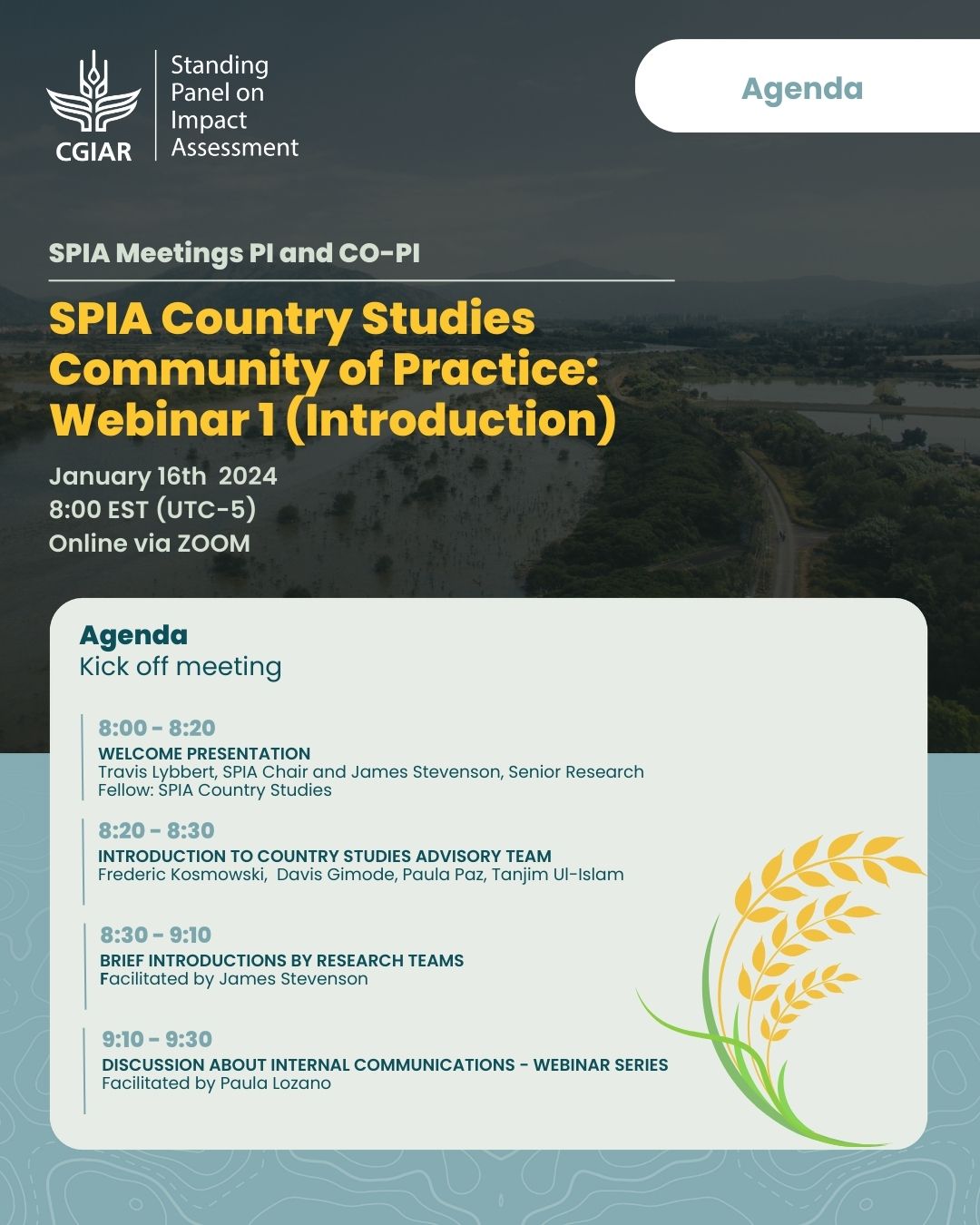
 

Facilitator(s)

  • James Stevenson

    Senior Research Fellow, SPIA Country Studies

Presentation(s)

  • Introduction Webinar#1

CGIAR Independent Advisory and Evaluation Service (IAES)

Alliance of Bioversity International and CIAT
Via di San Domenico,1
00153 Rome, Italy
  • IAES@cgiar.org
  • (39-06) 61181

Follow Us

  • LinkedIn
  • Twitter
  • YouTube
JOIN OUR MAILING LIST
  • Terms and conditions
  • © CGIAR 2026

IAES provides operational support as the secretariat for the Independent Science for Development Council and the Standing Panel on Impact Assessment, and implements CGIAR’s multi-year, independent evaluation plan as approved by the CGIAR’s System Council.