

  • Home
  • About
  • Who we are
  • News
  • Events
  • Publications
  • Search
  • Independent Science for Development CouncilISDC
    • Home
    • Who we are
    • News
    • Events
    • Publications
    • Featured Projects
      • Inclusive Innovation
        • Agricultural Systems Special Issue
      • Proposal Reviews
        • 2025-30 Portfolio
        • Reform Advice
      • Foresight & Trade-Offs
        • Megatrends
      • QoR4D
      • Comparative Advantage
  • Standing Panel on Impact AssessmentSPIA
    • Who We Are
      • SPIA Team
      • Our Mandate
      • Impact Assessment Focal Points
      • SPIA Affiliates Network
    • What We Do
      • Country Studies
        • Community of Practice
      • Causal Impact Assessment
      • Use of Evidence
    • Where We Work
      • Bangladesh Study
      • Ethiopia Study
      • Uganda Study
      • Vietnam Study
    • Resources
      • Publications
      • Events
      • SPIA-emLab Agricultural Interventions Database
      • News & Blogs
        • Blog Series on Qualitative Methods for Impact Assessment
      • Webinars
  • Evaluation
    • Who we are
    • News
    • Events
    • Publications
    • Evaluations
      • Science Group Evaluations
      • Learning on CGIAR's Ways of Working
      • Platform Evaluations
        • CGIAR Genebank Platform Evaluation
        • CGIAR GENDER Platform Evaluation
        • CGIAR Excellence in Breeding Platform
        • CGIAR Platform for Big Data in Agriculture
    • Framework and Policy
      • Evaluative Learning Hub
      • Evaluation Method Notes Resource Hub
      • Management Engagement and Response Resource Hub
      • Evaluating Quality of Science for Sustainable Development
      • Evaluability Assessments – Enhancing Pathway to Impact
      • Evaluation Guidelines
  • Independent Science for Development CouncilISDC
  • Standing Panel on Impact AssessmentSPIA
  • Evaluation
Back to IAES Main Menu
  • Home
  • Who we are
  • News
  • Events
  • Publications
  • Featured Projects
    • Inclusive Innovation
      • Agricultural Systems Special Issue
    • Proposal Reviews
      • 2025-30 Portfolio
      • Reform Advice
    • Foresight & Trade-Offs
      • Megatrends
    • QoR4D
    • Comparative Advantage
Photo: © Stephan Gladieu / World Bank
Video

Staple Crop Yields Alone Will Not Solve Poverty

You are here

  • Home
  • Independent Science for Development CouncilISDC
  • News
  • Staple Crop Yields Alone Will Not Solve Poverty

An exclusive focus on improving staple crop yields in developing countries is increasingly questioned as an effective pathway out of poverty for smallholder producers. Although there is still a major focus on increasing food supply in developing country policies, there is also increasing interest in supporting a more diverse and nutritious set of agricultural products.

In this interview, Prabhu Pingali, ISPC Member and Professor, Dyson School of Applied Economics and Management, Cornell University, USA explains why moving away from ‘staple crop fundamentalism’ to a more diversified food system is crucial as we look at shift towards nutrition security.
Share on

Science ISDC
Jun 28, 2018

Related News

Posted on
03 Aug 2026
by

Join ISDC: Vacancies for Up to Two New Members

Posted on
08 Jul 2026
by
  • Ines Gonzalez de Suso
  • Magali Garcia

La primera reunión presencial del ISDC en 2026 en Lima: conectando con la ciencia del CIP (y sus papas)

Posted on
30 Mar 2026
by
  • Domagoj Vrbos
  • Lesley Torrance

A Lasting Impact: Reflecting on Nompumelelo Obokoh’s Contributions to ISDC

More News

Related Publications

Assessments & Commentaries
Science ISDC
Issued on 2026

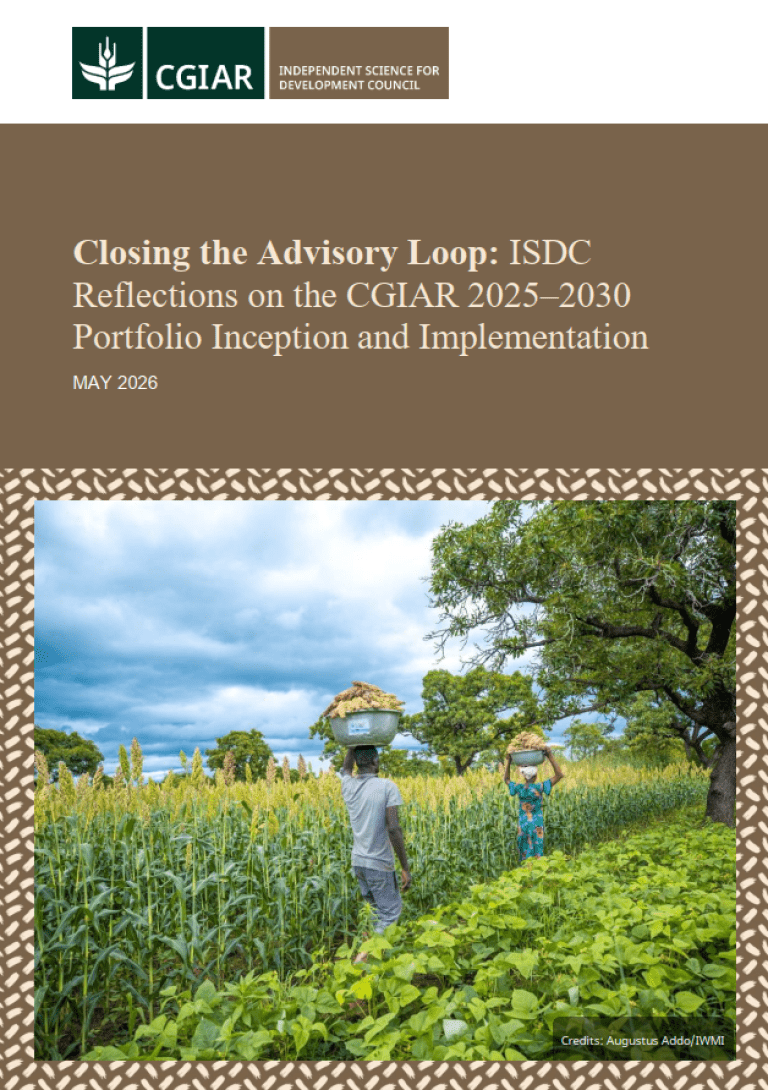
Closing the Advisory Loop: ISDC Reflections on the CGIAR 2025–2030 Portfolio Inception and Implementation

Strategic & Synthesis Studies
Science ISDC
Issued on 2025

Brief Primer on Tools to Prioritize a Research and Innovation Portfolio in a Complex System Involving Multiple Decision Makers

ISDC review cover page
Assessments & Commentaries
Science ISDC
Issued on 2025

ISDC Review of 2025-2030 Research and Innovation Inception Reports

More publications

CGIAR Independent Advisory and Evaluation Service (IAES)

Alliance of Bioversity International and CIAT
Via di San Domenico,1
00153 Rome, Italy
  • IAES@cgiar.org
  • (39-06) 61181

Follow Us

  • LinkedIn
  • Twitter
  • YouTube
JOIN OUR MAILING LIST
  • Terms and conditions
  • © CGIAR 2026

IAES provides operational support as the secretariat for the Independent Science for Development Council and the Standing Panel on Impact Assessment, and implements CGIAR’s multi-year, independent evaluation plan as approved by the CGIAR’s System Council.