  • Home
  • About
  • Who we are
  • News
  • Events
  • Publications
  • Search
  • Independent Science for Development CouncilISDC
    • Home
    • Who we are
    • News
    • Events
    • Publications
    • Featured Projects
      • Inclusive Innovation
        • Agricultural Systems Special Issue
      • Proposal Reviews
        • 2025-30 Portfolio
        • Reform Advice
      • Foresight & Trade-Offs
        • Megatrends
      • QoR4D
      • Comparative Advantage
  • Standing Panel on Impact AssessmentSPIA
    • Who We Are
      • SPIA Team
      • Our Mandate
      • Impact Assessment Focal Points
      • SPIA Affiliates Network
    • What We Do
      • Country Studies
        • Community of Practice
      • Causal Impact Assessment
      • Use of Evidence
    • Where We Work
      • Bangladesh Study
      • Ethiopia Study
      • Uganda Study
      • Vietnam Study
    • Resources
      • Publications
      • Events
      • SPIA-emLab Agricultural Interventions Database
      • News & Blogs
        • Blog Series on Qualitative Methods for Impact Assessment
      • Webinars
  • Evaluation
    • Who we are
    • News
    • Events
    • Publications
    • Evaluations
      • Science Group Evaluations
      • Learning on CGIAR's Ways of Working
      • Platform Evaluations
        • CGIAR Genebank Platform Evaluation
        • CGIAR GENDER Platform Evaluation
        • CGIAR Excellence in Breeding Platform
        • CGIAR Platform for Big Data in Agriculture
    • Framework and Policy
      • Evaluative Learning Hub
      • Evaluation Method Notes Resource Hub
      • Management Engagement and Response Resource Hub
      • Evaluating Quality of Science for Sustainable Development
      • Evaluability Assessments – Enhancing Pathway to Impact
      • Evaluation Guidelines
  • Independent Science for Development CouncilISDC
  • Standing Panel on Impact AssessmentSPIA
  • Evaluation
Back to IAES Main Menu
  • Who We Are
    • SPIA Team
    • Our Mandate
    • Impact Assessment Focal Points
    • SPIA Affiliates Network
  • What We Do
    • Country Studies
      • Community of Practice
    • Causal Impact Assessment
    • Use of Evidence
  • Where We Work
    • Bangladesh Study
    • Ethiopia Study
    • Uganda Study
    • Vietnam Study
  • Resources
    • Publications
    • Events
    • SPIA-emLab Agricultural Interventions Database
    • News & Blogs
      • Blog Series on Qualitative Methods for Impact Assessment
    • Webinars
Technical Notes

Does An Innovation’s Reach Reveal Anything About Its Impact? Under The Right Conditions: Possibly

You are here

  • Home
  • Standing Panel on Impact AssessmentSPIA
  • Publications by organization
  • Does An Innovation’s Reach Reveal Anything About Its Impact? Under The Right Conditions: Possibly

Abstract

Impact—the extent to which a specific innovation causally affects a target outcome—is an ideal measure of a program’s success. However, impact evaluations are time- and resource-intensive, making them unavailable in many circumstances. By contrast, measuring the reach of an innovation, i.e., the number of adopters, is more straightforward. As a result, measures of reach are more prevalent than causal impact estimates.


This note discusses the relationship between reach and impact. It is motivated by the mandate of the Standing Panel on Impact Assessment (SPIA) of the CGIAR and draws on SPIA country studies, which explicitly focus on measuring the reach of CGIAR innovations, to illustrate the possibilities and pitfalls of using reach to infer impact.


Whereas the reach of an innovation in a given population may reveal something about its impact, the conditions under which reach may be a useful proxy for impact often deviate sharply from on-the-ground realities. In most settings, understanding the total benefits of an innovation requires reliable evidence of both reach and impact.

Citation

Brooks, M., Lybbert, T.J., & Walker, M. (2025). Does an Innovation’s Reach Reveal Anything About its Impact? Under the Right Conditions: Possibly. Technical Note N.12. Rome. SPIA.

Author(s)

Brooks, M., Lybbert, T.J., & Walker, M.
Share on

Impact SPIA
Issued on 2025
  • Download

Related Publications

Special Issues
Impact SPIA
Issued on 2026

Call for Proposals — SPIA Small Grants: Measuring CGIAR's Policy Influence

UofE Strategy
Guidelines
Impact SPIA
Issued on 2026

The SPIA Approach to Use of Evidence

Assessments & Commentaries
Impact SPIA
Issued on 2026

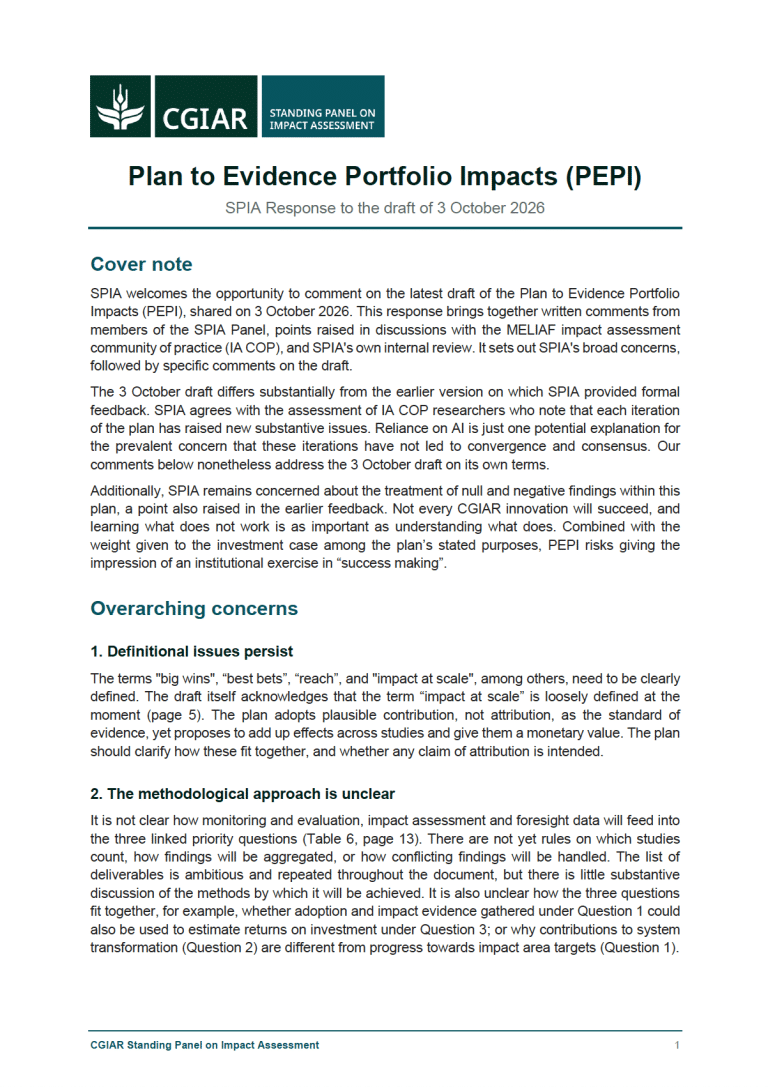
SPIA Feedback: Portfolio Impact Assessment Plan Draft Concept Note

More publications

Related News

Blog
Impact SPIA
23 Jul 2026

Nutrients in Search of a Household: Biofortification's Next Chapter Within CGIAR

Call for proposals
Impact SPIA
02 Jul 2026

SPIA Small Grants: Measuring CGIAR's Policy Influence — Call for Proposals Now Open

Blog
Impact SPIA
01 Jul 2026

What's Really Growing in Viet Nam's Rice Fields?

More News

CGIAR Independent Advisory and Evaluation Service (IAES)

Alliance of Bioversity International and CIAT
Via di San Domenico,1
00153 Rome, Italy
  • IAES@cgiar.org
  • (39-06) 61181

Follow Us

  • LinkedIn
  • Twitter
  • YouTube
JOIN OUR MAILING LIST
  • Terms and conditions
  • © CGIAR 2026

IAES provides operational support as the secretariat for the Independent Science for Development Council and the Standing Panel on Impact Assessment, and implements CGIAR’s multi-year, independent evaluation plan as approved by the CGIAR’s System Council.