
Biofortified crops that fight micronutrient deficiencies, biological treatments that keep dangerous toxins out of the food supply, and farming practices that store carbon in the soil are exactly the kinds of innovations that governments, CGIAR centers, and development organizations have spent decades promoting to smallholder farmers in low-income countries. Yet even when these technologies are known to deliver outcomes that we care about socially, adoption remains well below what would be desirable from society’s perspective.
In a new PNAS Perspective, we suggest a framework for understanding why farmers do not adopt socially beneficial innovations at scale. The problem is rarely just a lack of awareness, high costs, or poor access; rather, it is typically rooted in a basic mismatch between what farmers are rewarded for and the benefits their actions create for others. We explore this misalignment through three very different cases: aflatoxin control, biofortified crops, and conservation agriculture. In each case, the innovation can generate substantial benefits for society, but farmers may receive only a fraction of that value.
The problem: farmers can’t be fully paid for what buyers can’t see
Many agricultural innovations promoted to smallholder farmers generate both private and social benefits. The problem is that markets do not always reward these broader benefits because socially valuable attributes are often difficult to observe without costly verification. Those verification costs are largely fixed, which puts them out of reach for smallholder farmers, who typically sell relatively small quantities. And if buyers cannot tell whether a farmer has adopted a particular practice or produced a product with a desirable attribute, they have little reason to pay more for it. The combination of unobservable quality, largely fixed verification costs, and small transaction volumes can therefore make markets for socially valuable attributes particularly difficult to develop for smallholder farmers. (The same problem may also arise where there is no market: a government willing to subsidize a socially beneficial practice still needs to verify that farmers have adopted it.)
Our paper frames this as an alignment problem between two types of return: the private return a farmer captures directly, such as higher yields, lower costs, or better health for their household, and the external return that accrues to others, such as improved consumer health, better nutrition, or a cleaner environment. When these external benefits cannot be observed, verified, and rewarded, they may be highly valuable to society but provide little incentive for the farmer to bear the costs of adoption.
Three innovations with different scaling barriers
We illustrate this framework with three cases in which the innovation has proven benefits, but adoption at scale has not followed.
- Aflatoxin control for food safety. Aflasafe, a biological control product that suppresses the toxin-producing fungus in maize and groundnuts, has been available in Africa since 2014. But clean and contaminated grains look essentially the same, so consumers who value food safety cannot easily identify or reward it. The roughly $20-per-hectare cost can further discourage farmers who typically spend little on purchased inputs. Portable testing technologies — inexpensive field-test kits and newer AI-based devices — could change this: once an invisible attribute can be measured reliably, markets can begin to reward farmers for producing it.
- Biofortified crops for improved nutrition. More than 284 biofortified crop varieties have been released across 22 African countries, yet adoption remains limited. Where the nutritional trait is visible, as with orange-fleshed sweet potato, the obstacle is beliefs and familiarity rather than market incentives: consumers who understand the benefit may value the crop, while those unfamiliar with its color may be reluctant. Where the trait is invisible, as with zinc-enriched rice, the problem is similar to that facing aflatoxin control: buyers cannot observe the nutritional advantage, making it difficult for markets to reward farmers for producing it.
- Conservation agriculture for environmental benefits. Reduced tillage, permanent soil cover, and crop rotation can improve soil health, water retention, and resilience to erratic rainfall, while also storing carbon. But many of the benefits farmers care about take years to materialize, while the costs — new equipment, additional labor, and possible short-term yield risks — come immediately. Farmers may therefore place less value on benefits they have not yet experienced. Meanwhile, the resilience benefits that accrue to society (such as averted emissions or greater yield stability of the farming system) cannot generally be captured by farmers without mechanisms such as payments for ecosystem services or carbon markets. Advances in satellite-based monitoring could make conservation agriculture adoption cheaper to verify and reward.
No single fix
Across all three cases, no single policy instrument — subsidies, certification, or extension training — is likely to close the adoption gap on its own. A subsidy can reduce upfront costs but cannot solve information problems. Certification can create a price premium but may be too expensive for smallholders. Training can change knowledge and perceptions but cannot create a market reward for a benefit that buyers cannot observe.
The figure below summarizes the central idea of our framework: adoption depends not only on whether an innovation creates value, but also on how much of that value the farmer can capture and when the costs and benefits occur. It highlights three broad ways an adoption gap can emerge. Farmers may be unable to capture benefits that accrue to others; they may face costs before benefits materialize; or they may lack the information needed to recognize the value of an unfamiliar technology. These mechanisms often overlap.
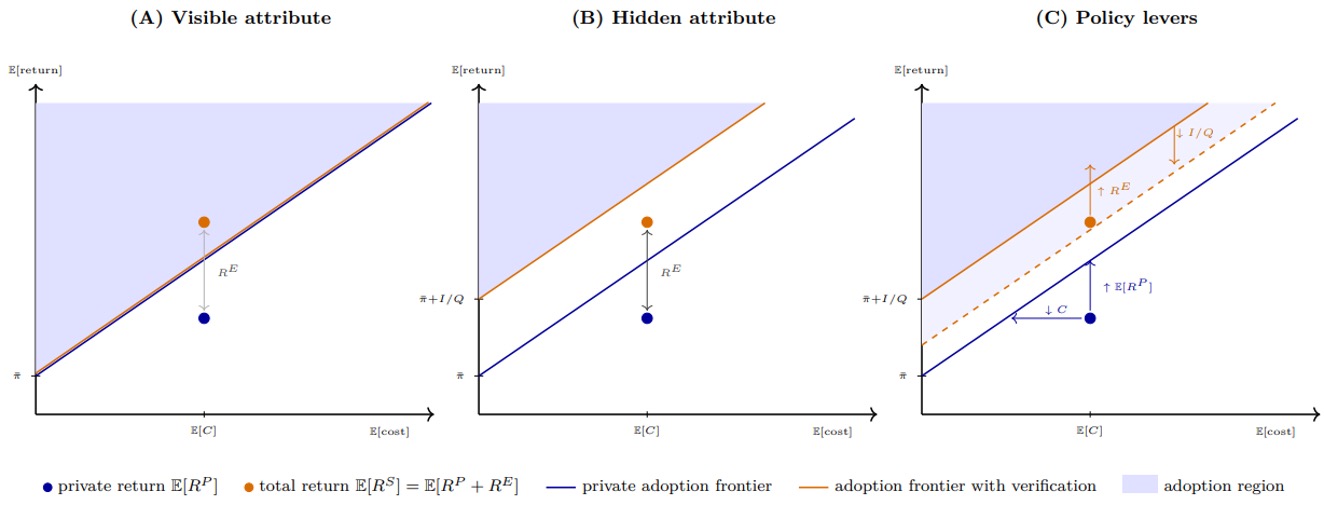
In the above graphic, each panel plots a farmer's expected cost of adopting a new practice against their expected return. Farmers adopt only when the return clears a minimum threshold (the shaded region). (A) When a trait is visible — like the orange flesh of vitamin-A-rich sweet potatoes — the farmer captures its value and adopts it. (B) When a trait is hidden, like the safety of aflatoxin-free maize, buyers can't verify it, so the farmer isn't paid for it and skips adoption — even though it benefits others. (C) Policy can close this gap four ways: lower costs (subsidies, credit), raise the farmer's own payoff (demonstrations, information), reward the hidden benefit directly (certification, PES payments), or shrink the cost of verifying it (testing infrastructure, cooperatives).
That overlap is why combinations of policies can work better than any single intervention. Cheaper verification can make an invisible benefit measurable, and therefore rewardable. Financing can reduce the burden of upfront costs. Information and training can make unfamiliar or delayed benefits more concrete. The right combination will depend on the nature of the adoption problem and the context.
Implications for the research-policy agenda
We propose three priorities for research and policy. First, we need better measurement on both sides of the equation: the societal benefits (e.g. health, nutrition, environment, and economic) that innovations generate, and the full public cost of the policies and systems needed to promote them.
Second, we need to look more closely at combinations of policy instruments. Instead of asking whether to subsidize, certify, or train, the more useful question is which combinations work together in a particular setting, and at what cost.
Third, the opportunity space is not fixed. Investments in information, market development, and low-cost verification can change the economics of adoption over time. An innovation that requires public support today may become commercially viable as private incentives grow, so today’s public investment can help create tomorrow’s self-sustaining market.
The goal is not simply to persuade farmers to adopt more technologies. It is to create conditions in which doing what is good for society also makes economic sense for the farmer.
To learn more, read the full study, Aligning Private Incentives with Societal Goals in Smallholder Agriculture, recently published in PNAS. This research was co-supported by the CGIAR Science Program on Policy Innovations, and the Standing Panel on Impact Assessment (SPIA).