
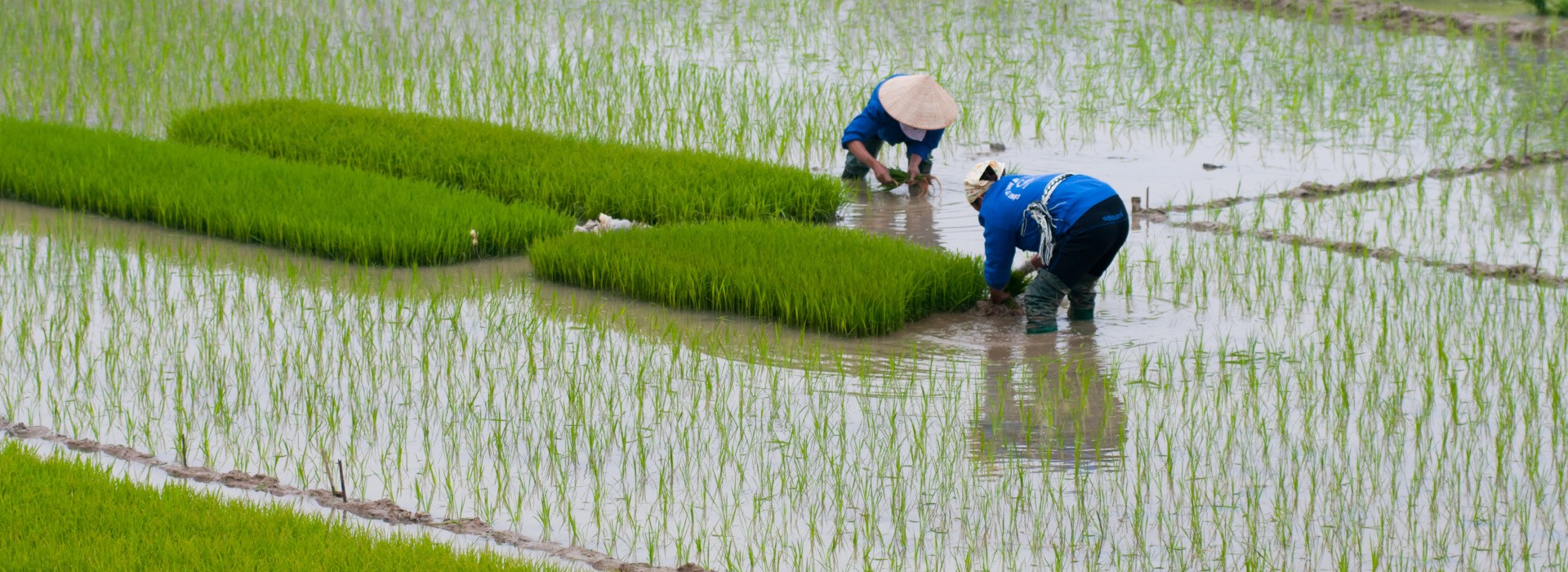
As the world's second-largest rice exporter, Viet Nam is one of the world’s so-called “rice bowls”. The country's rice farmers feed millions of people domestically and produce more than 8 million tons of rice for export each year, with key markets including Japan and the European Union.
But what are farmers actually growing? And are decades of investment in developing improved rice varieties paying off?
As part of our Viet Nam Country Study, members of the SPIA team set out to answer these questions, using DNA fingerprinting and household survey data to carry out the first nationwide analysis of Vietnamese rice varieties.
Bringing improved varieties to market
The Đổi Mới reforms of 1986 marked the beginning of Viet Nam's shift from subsistence farming to market-oriented agriculture. With an eye toward boosting rice production for export, two factors became critical: yields needed to stay consistent, and rice needed to meet consumer-oriented standards like taste and aroma for international buyers.
This pushed the country toward improved rice varieties, which included strains bred not only to resist pests and harsh climate conditions, but to taste better to a global customer base. Since 1984, Viet Nam has certified 565 improved rice varieties nationally.
Since the 2010s, most of these strains are products of molecular breeding, a technique that lets scientists pinpoint the exact genetic regions (known as Quantitative Trait Loci, or QTLs) responsible for the expression of a given trait, rather than simply selecting for it by eye. The Vietnamese agriculture sector has rapidly embraced these tools. But it still wasn’t clear to which extent improved varieties had become established in farmers' fields.
What are farmers growing?
To find out, SPIA researchers embedded a rice crop-sampling module into Viet Nam's National Household Living Standards Survey (VHLSS) in 2022. Trained enumerators visited 832 rice-growing households across the country, collected leaf samples from farmers' plots, and shipped them to a lab for DNA fingerprinting. Each sample was matched against a reference library of 122 officially released Vietnamese varieties and 174 elite breeding lines from the International Rice Research Institute (IRRI).
The results point to significant varietal diversity. Just over half of rice farmers (51%) were growing improved varieties, or strains that matched a known, certified cultivar. The rest were growing "unassigned" samples: likely traditional landraces or local varieties not held in the IRRI reference library, concentrated especially in the northern highlands and mountainous regions.
Improved varieties carried substantially more beneficial QTLs than unassigned samples (an average of 18, compared to 13 for the unassigned samples), across yield, grain quality, disease resistance, and stress tolerance. That gap is statistically robust, and it reflects that breeding advancements are meaningfully making it all the way to the field.
Notably, farmers were more likely to grow varieties with a higher density of QTLs. Each additional trait-related QTL in a variety was associated with a roughly 0.9 percentage point increase in its provincial adoption rate. In other words: even without necessarily knowing genetic details of the seeds they’re growing, farmers seem to be gravitating toward improved varieties.
Among specific trait categories, tolerance to abiotic stress (drought, flooding, salinity) showed the most consistent link to adoption, suggesting that resilience to environmental pressure is shaping what farmers choose to plant.
No single variety dominated. The most widely cultivated were BT7 (nearly 8% of households), OM4900 (7%), and Dai Thom 8 (just under 6%). Unlike in Bangladesh, where a handful of legacy "mega-varieties" released in the 1990s still dominate the landscape decades later, Viet Nam shows a more diverse varietal turnover.
We also found encouraging evidence on the age of improved varieties in the field: an average of 14 years between release and adoption. Cutting that gap is a priority for many countries. India, for instance, restricts subsidies for cultivars older than 10 years to push farmers toward modern, climate-resilient alternatives. And while most paddies in Viet Nam don’t yet meet that standard, it fares better relative to other countries in the region like Bangladesh, which has a 21-24-year average.
Barriers to access
But while many farmers seem to be embracing improved varieties, uptake is uneven across regions and socioeconomic groups. Adoption of improved varieties is significantly lower among ethnic minority households and those in communes classified as poor (by 14.6 and 17.3 percentage points respectively) — an imbalance likely caused by a combination of limited seed access, credit constraints, and a mismatch between the qualities of high-performing varieties and the needs of marginalized farmers.
A short toward decentralized, farmer-centric models may help bridge these gaps. These may include:
- Participatory Varietal Selection, which directly involves farmers in the seed selection process and can help ensure that the varieties they grown align with specific trait preferences demanded by resource-constrained producers.
- Village-Based Seed Enterprises, which help address “last-mile” delivery challenges by establishing local seed supply chains and reduce reliance on national and international suppliers.
What’s next?
In today’s tumultuous agricultural research for development (AR4D) funding environment, understanding the impact of agricultural innovations is particularly important. And for CGIAR research centers, understanding whether key innovations like improved seed varieties are reaching farmers — and which farmers — is not a minor question. This study shows that it can be answered.
Like all rigorous research, this study is upfront about its limits. Sample collection covered three cropping seasons, but unevenly (as nearly three-quarters of samples came from the winter-spring season alone). Hence, the results may not fully capture how farmer preferences shift across the year. Additionally, since farmers' choices are shaped by what seed is available to farmers locally, it's difficult to fully separate genuine preference from the limits of supply.
Despite these limitations, we have found a way to reliably measure whether genetic investment in crop improvement is actually paying off for smallholders. One could apply similar measurements in other country contexts and crops.


