
  • Home
  • About
  • Who we are
  • News
  • Events
  • Publications
  • Search
  • Independent Science for Development CouncilISDC
    • Home
    • Who we are
    • News
    • Events
    • Publications
    • Featured Projects
      • Inclusive Innovation
        • Agricultural Systems Special Issue
      • Proposal Reviews
        • 2025-30 Portfolio
        • Reform Advice
      • Foresight & Trade-Offs
        • Megatrends
      • QoR4D
      • Comparative Advantage
  • Standing Panel on Impact AssessmentSPIA
    • Who We Are
      • SPIA Team
      • Our Mandate
      • Impact Assessment Focal Points
      • SPIA Affiliates Network
    • What We Do
      • Country Studies
        • Community of Practice
      • Causal Impact Assessment
      • Use of Evidence
    • Where We Work
      • Bangladesh Study
      • Ethiopia Study
      • Uganda Study
      • Vietnam Study
    • Resources
      • Publications
      • News & Blogs
        • Blog Series on Qualitative Methods for Impact Assessment
      • Data Resources
        • Stocktake Data
        • Replication Files
        • SPIA-emLab Agricultural Interventions Database
      • Webinars
      • Events
      • Rigorously Speaking: The SPIA Newsletter
  • Evaluation
    • Who we are
    • News
    • Events
    • Publications
    • Evaluations
      • CGIAR Center External Reviews (CER)
      • Learning on CGIAR's Ways of Working
      • Science Group Evaluations
      • Platform Evaluations
        • CGIAR Genebank Platform Evaluation
        • CGIAR GENDER Platform Evaluation
        • CGIAR Excellence in Breeding Platform
        • CGIAR Platform for Big Data in Agriculture
    • Framework and Policy
      • Evaluative Learning Hub
      • Evaluation Method Notes Resource Hub
      • Management Engagement and Response Resource Hub
      • Evaluating Quality of Science for Sustainable Development
      • Evaluability Assessments – Enhancing Pathway to Impact
      • Evaluation Guidelines
  • Independent Science for Development CouncilISDC
  • Standing Panel on Impact AssessmentSPIA
  • Evaluation
Back to IAES Main Menu
  • Who We Are
    • SPIA Team
    • Our Mandate
    • Impact Assessment Focal Points
    • SPIA Affiliates Network
  • What We Do
    • Country Studies
      • Community of Practice
    • Causal Impact Assessment
    • Use of Evidence
  • Where We Work
    • Bangladesh Study
    • Ethiopia Study
    • Uganda Study
    • Vietnam Study
  • Resources
    • Publications
    • News & Blogs
      • Blog Series on Qualitative Methods for Impact Assessment
    • Data Resources
      • Stocktake Data
      • Replication Files
      • SPIA-emLab Agricultural Interventions Database
    • Webinars
    • Events
    • Rigorously Speaking: The SPIA Newsletter
Technical Notes

Interpolating and Extrapolating Impact Estimates: Implications of Ex Post Impact Evaluation Evidence for Projecting Benefits Ex Ante

You are here

  • Home
  • Standing Panel on Impact AssessmentSPIA
  • Publications by organization
  • Interpolating and Extrapolating Impact Estimates: Implications of Ex Post Impact Evaluation Evidence for Projecting Benefits Ex Ante

Abstract

The purpose of this note is to summarize empirical literature in economics addressing two key evidence challenges: (i) scaling up innovations or interventions that have shown promising impacts at smaller scales, and (ii) assessing the external validity of impact estimates. In this context, scaling refers to expanding an innovation’s reach—across larger populations, geographic areas, or time periods—based on existing evidence. External validity concerns the extent to which study results can be generalized to different contexts. We aim to provide guidance on the challenges and limitations of transferring impact estimates both within and beyond their original study settings.

Citation

Labarta, R., Lybbert, T.J., Melaku, A.B, Walker, M., & Yang, C. (2025). Interpolating and extrapolating impact estimates: Implications of ex post impact evaluation evidence for projecting benefits ex ante. Technical Note N.13. Rome: SPIA. 

Author(s)

Ricardo Labarta, Travis J. Lybbert, Astewale Bimr Melaku, Madeleine Walker, Chunhao Yang.

Publisher

SPIA
Share on

Impact SPIA
Issued on 2025
  • Download the report here
  • Download

Related Publications

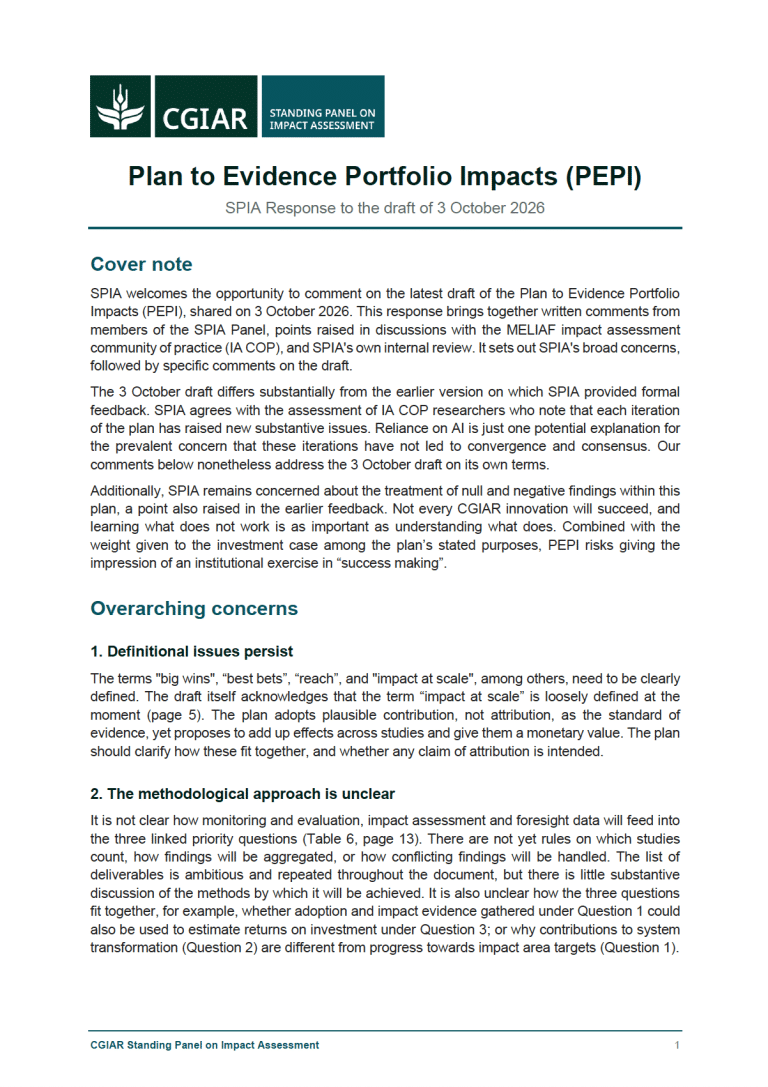
Cover page of PEPI response
Assessments & Commentaries
Impact SPIA
Issued on 2026

Plan to Evidence Portfolio Impacts (PEPI): SPIA Response to the draft of 3 October 2026

Special Issues
Impact SPIA
Issued on 2026

Call for Proposals — SPIA Small Grants: Measuring CGIAR's Policy Influence

UofE Strategy
Guidelines
Impact SPIA
Issued on 2026

The SPIA Approach to Use of Evidence

More publications

Related News

Blog
Impact SPIA
26 Oct 2026

SPIA Policy Grants: Meet the Grantees

Blog
Impact SPIA
05 Oct 2026

When doing good doesn’t pay: Why smallholder farmers don’t adopt socially beneficial technologies at scale

NRDC students in the computer lab at the aquaculture training center
Blog
Impact SPIA
25 Sep 2026

Same data, same code, same results? Insights on computational reproducibility

More News

CGIAR Independent Advisory and Evaluation Service (IAES)

Alliance of Bioversity International and CIAT
Via di San Domenico,1
00153 Rome, Italy
  • IAES@cgiar.org
  • (39-06) 61181

Follow Us

  • LinkedIn
  • Twitter
  • YouTube
JOIN OUR MAILING LIST
  • Terms and conditions
  • © CGIAR 2026

IAES provides operational support as the secretariat for the Independent Science for Development Council and the Standing Panel on Impact Assessment, and implements CGIAR’s multi-year, independent evaluation plan as approved by the CGIAR’s System Council.