
  • Home
  • About
  • Who we are
  • News
  • Events
  • Publications
  • Search
  • Independent Science for Development CouncilISDC
    • Home
    • Who we are
    • News
    • Events
    • Publications
    • Featured Projects
      • Inclusive Innovation
        • Agricultural Systems Special Issue
      • Proposal Reviews
        • 2025-30 Portfolio
        • Reform Advice
      • Foresight & Trade-Offs
        • Megatrends
      • QoR4D
      • Comparative Advantage
  • Standing Panel on Impact AssessmentSPIA
    • Who We Are
      • SPIA Team
      • Our Mandate
      • Impact Assessment Focal Points
      • SPIA Affiliates Network
    • What We Do
      • Country Studies
        • Community of Practice
      • Causal Impact Assessment
      • Use of Evidence
    • Where We Work
      • Bangladesh Study
      • Ethiopia Study
      • Uganda Study
      • Vietnam Study
    • Resources
      • Publications
      • News & Blogs
        • Blog Series on Qualitative Methods for Impact Assessment
      • Data Resources
        • Stocktake Data
        • Replication Files
        • SPIA-emLab Agricultural Interventions Database
      • Webinars
      • Events
      • Rigorously Speaking: The SPIA Newsletter
  • Evaluation
    • Who we are
    • News
    • Events
    • Publications
    • Evaluations
      • CGIAR Center External Reviews (CER)
      • Learning on CGIAR's Ways of Working
      • Science Group Evaluations
      • Platform Evaluations
        • CGIAR Genebank Platform Evaluation
        • CGIAR GENDER Platform Evaluation
        • CGIAR Excellence in Breeding Platform
        • CGIAR Platform for Big Data in Agriculture
    • Framework and Policy
      • Evaluative Learning Hub
      • Evaluation Method Notes Resource Hub
      • Management Engagement and Response Resource Hub
      • Evaluating Quality of Science for Sustainable Development
      • Evaluability Assessments – Enhancing Pathway to Impact
      • Evaluation Guidelines
  • Independent Science for Development CouncilISDC
  • Standing Panel on Impact AssessmentSPIA
  • Evaluation
Back to IAES Main Menu
  • Who we are
  • News
  • Events
  • Publications
  • Evaluations
    • CGIAR Center External Reviews (CER)
    • Learning on CGIAR's Ways of Working
    • Science Group Evaluations
    • Platform Evaluations
      • CGIAR Genebank Platform Evaluation
      • CGIAR GENDER Platform Evaluation
      • CGIAR Excellence in Breeding Platform
      • CGIAR Platform for Big Data in Agriculture
  • Framework and Policy
    • Evaluative Learning Hub
    • Evaluation Method Notes Resource Hub
    • Management Engagement and Response Resource Hub
    • Evaluating Quality of Science for Sustainable Development
    • Evaluability Assessments – Enhancing Pathway to Impact
    • Evaluation Guidelines
Evaluation Reports & Reviews

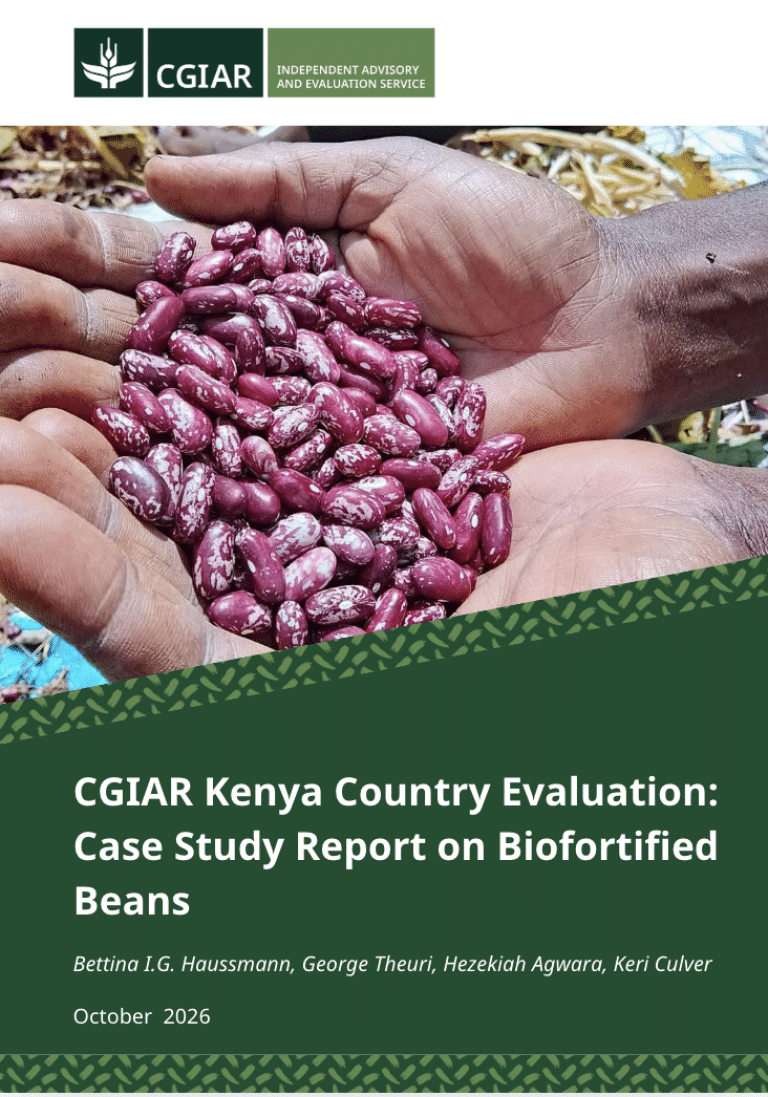
CGIAR Kenya Country Evaluation: Case Study Report on Biofortified Beans

You are here

  • Home
  • Evaluation
  • Publications
  • CGIAR Kenya Country Evaluation: Case Study Report on Biofortified Beans

Abstract

This case study examines the development, scaling and emerging outcomes of biofortified beans in Kenya, codeveloped by the Kenya Agricultural and Livestock Research Organization (KALRO) and other national partners with support from the Alliance of Bioversity International and CIAT through the Pan-Africa Bean Research Alliance (PABRA), HarvestPlus and other partners. Conducted as part of the CGIAR Kenya Country Evaluation, it uses a qualitative, realist approach drawing on document review, available quantitative data and consultations with 52 stakeholders. The innovation is well aligned with national priorities, and six biofortified varieties have been released since 2017, although dissemination remains concentrated on one variety, Nyota. A long-term partnership model combining national leadership with regional collaboration has enabled progress from variety release to farmer production and commercial and institutional markets. However, evidence on sustained adoption and on nutrition, livelihood and resilience outcomes in Kenya remains limited. The case highlights the value of CGIAR science embedded in nationally owned partnerships and identifies three opportunities: using the PABRA experience for learning across CGIAR, deploying the wider varietal portfolio to suit local contexts, and generating stronger outcome evidence.

Citation

Haussmann, B. I.G., Theuri, G., Agwara, H., Culver, K. 2026. CGIAR Kenya Country Evaluation: Case Study Report on Biofortified Beans. Rome: CGIAR Independent Advisory and Evaluation Service (IAES) 

Author(s)

Bettina I.G. Haussmann, George Theuri, Hezekiah Agwara, Keri Culver

Publisher

CGIAR Independent Advisory and Evaluation Service (IAES), Evaluation Function
Share on

Evaluation
Issued on 2026
Biofortified beans
  • Download

Related Publications

Biofortified beans
Evaluation Reports & Reviews
Evaluation
Issued on 2026

CGIAR Kenya Country Evaluation: Case Study Report on Biofortified Beans

Reference Materials
Evaluation
Issued on 2026

CGIAR Center External Reviews: Template Terms of Reference

Evaluation Reports & Reviews
Evaluation
Issued on 2026

CGIAR Center External Reviews: International Water Management Institute (IWMI) Review Report

More publications

CGIAR Independent Advisory and Evaluation Service (IAES)

Alliance of Bioversity International and CIAT
Via di San Domenico,1
00153 Rome, Italy
  • IAES@cgiar.org
  • (39-06) 61181

Follow Us

  • LinkedIn
  • Twitter
  • YouTube
JOIN OUR MAILING LIST
  • Terms and conditions
  • © CGIAR 2026

IAES provides operational support as the secretariat for the Independent Science for Development Council and the Standing Panel on Impact Assessment, and implements CGIAR’s multi-year, independent evaluation plan as approved by the CGIAR’s System Council.