
Main menu

  • Home
  • About
  • Who we are
  • News
  • Events
  • Publications
  • Search

Secondary Menu

  • Independent Science for Development CouncilISDC
    • Home
    • Who we are
    • News
    • Events
    • Publications
    • Featured Projects
      • Inclusive Innovation
        • Agricultural Systems Special Issue
      • Proposal Reviews
        • 2025-30 Portfolio
        • Reform Advice
      • Foresight & Trade-Offs
        • Megatrends
      • QoR4D
      • Comparative Advantage
  • Standing Panel on Impact AssessmentSPIA
    • About
      • Who we are
      • Our Mandate
      • Impact Assessment Focal Points
      • SPIA Affiliates Network
    • Our Work
      • Country Studies
        • Community of Practice
        • Bangladesh Study
        • Ethiopia Study
        • Uganda Study
        • Vietnam Study
      • Causal Impact Assessment
      • Use of Evidence
      • Cross-Cutting Areas
        • Capacity Strengthening
        • Methods and Measurement
        • Guidance to IDTs
    • Resources
      • Publications
      • Blog Series on Qualitative Methods for Impact Assessment
      • SPIA-emLab Agricultural Interventions Database
    • Activities
      • News
      • Events
      • Webinars
  • Evaluation
    • Who we are
    • News
    • Events
    • Publications
    • Evaluations
      • Science Group Evaluations
      • Learning on CGIAR's Ways of Working
      • Platform Evaluations
        • CGIAR Genebank Platform Evaluation
        • CGIAR GENDER Platform Evaluation
        • CGIAR Excellence in Breeding Platform
        • CGIAR Platform for Big Data in Agriculture
    • Framework and Policy
      • Evaluative Learning Hub
      • Evaluation Method Notes Resource Hub
      • Management Engagement and Response Resource Hub
      • Evaluating Quality of Science for Sustainable Development
      • Evaluability Assessments – Enhancing Pathway to Impact
      • Evaluation Guidelines
  • Independent Science for Development CouncilISDC
  • Standing Panel on Impact AssessmentSPIA
  • Evaluation
Back to IAES Main Menu

Secondary Menu

  • Who we are
  • News
  • Events
  • Publications
  • Evaluations
    • Science Group Evaluations
    • Learning on CGIAR's Ways of Working
    • Platform Evaluations
      • CGIAR Genebank Platform Evaluation
      • CGIAR GENDER Platform Evaluation
      • CGIAR Excellence in Breeding Platform
      • CGIAR Platform for Big Data in Agriculture
  • Framework and Policy
    • Evaluative Learning Hub
    • Evaluation Method Notes Resource Hub
    • Management Engagement and Response Resource Hub
    • Evaluating Quality of Science for Sustainable Development
    • Evaluability Assessments – Enhancing Pathway to Impact
    • Evaluation Guidelines
Strategic & Synthesis Studies

Evaluability Assessment of CGIAR’s Portfolio 2025-2030: Synthesis Report

You are here

  • Home
  • Evaluation
  • Publications
  • Evaluability Assessment of CGIAR’s Portfolio 2025-2030: Synthesis Report

Abstract

The Evaluability Assessment (EA) of 13 Programs and Accelerators (P/As) in CGIAR’s 2025-30 Research Portfolio under the 2030 Research and Innovation Strategy aligns with the System Council-endorsed Multi-Year Evaluation Plan (MYEP), under the 2025-27 Workplan for CGIAR's Independent Advisory and Evaluation Service (IAES) (SC/M21/DP5). The purpose of the EA synthesis was to identify portfolio-wide patterns in evaluability, assess the extent to which the Portfolio is positioned for credible future evaluations, and make recommendations to strengthen evaluability across the system.

The synthesis found that while the Portfolio demonstrates strong conceptual design and improved institutionalization of monitoring, evaluation, learning and impact assessment (MELIA), important constraints continue to limit evaluability in practice. These include weakly operationalized theories of change, fragmented evidence and learning systems, uneven integration of gender, equality and inclusion, short-term outcome horizons, limited evaluation readiness, and weak links between resources and performance. The synthesis offers four system-level recommendations to support stronger mid-line evaluations and more coherent portfolio-wide learning, accountability, and evidence generation across CGIAR, namely:
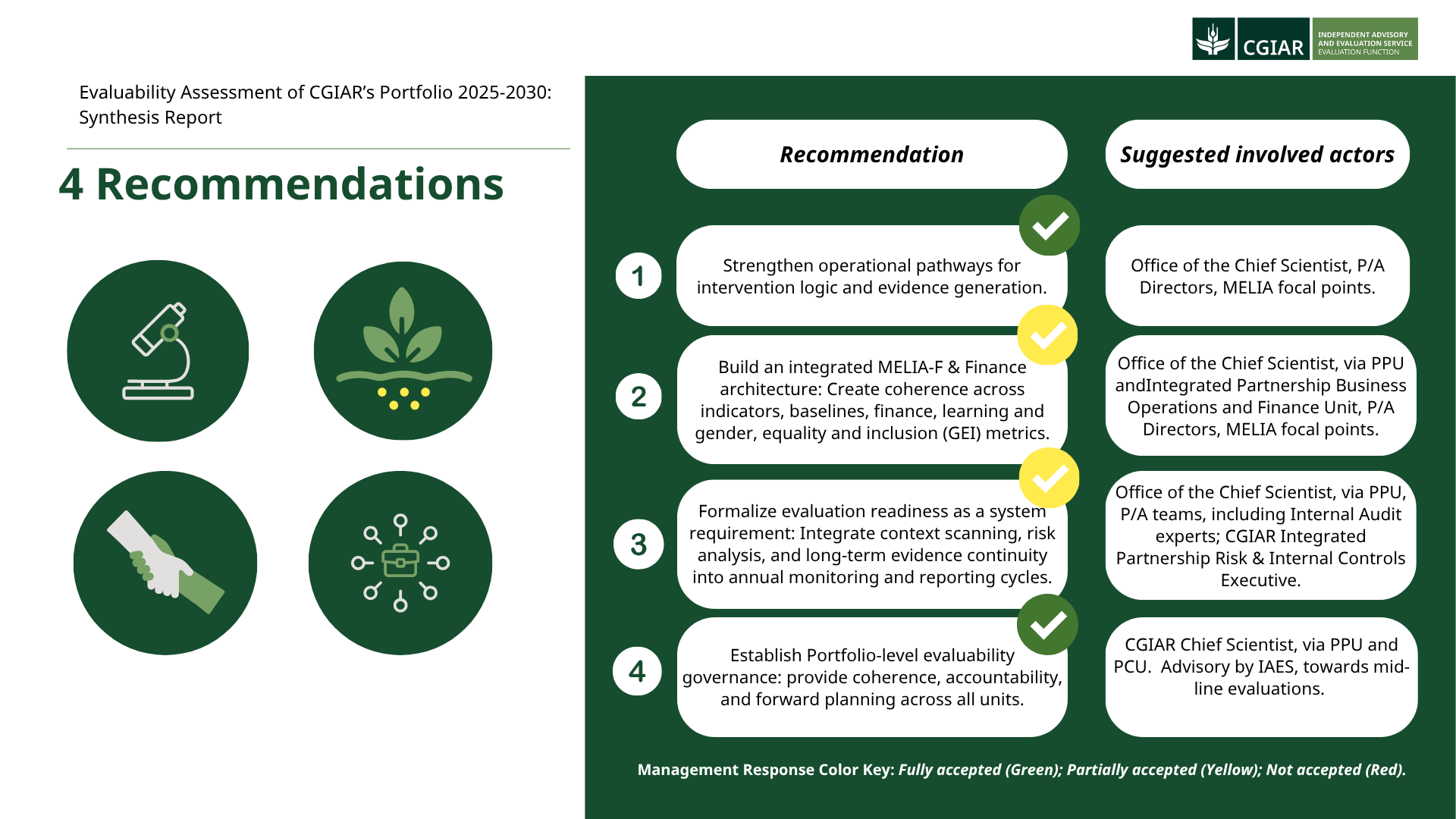
  1. Strengthen operational pathways for intervention logic and evidence generation
  2. Build an integrated MELIA-F & Finance architecture
  3. Formalize evaluation readiness as a system requirement
  4. Establish Portfolio-level evaluability governance

The status of implementing above recommendations by CGIAR management is monitored in the CGIAR’s tracker here.

Explore the IAES Evaluability Assessment (EA) Resource Hub.

Citation

Jersild, A., Lenne, J., Gullotta, G., Molinari, M. M., Negroustoueva, S. 2026. Evaluability Assessments of CGIAR’s Portfolio 2025-2030: Synthesis Report. Rome: CGIAR Independent Advisory and Evaluation Service (IAES), Evaluation Function. https://iaes.cgiar.org/evaluation

Author(s)

Jersild, A., Lenne, J., Gullotta, G., Molinari, M. M., Negroustoueva, S.

Publisher

Independent Advisory and Evaluation Service (IAES)

Share on

Evaluation
Issued on 2026
cover
  • Download
  • Annexes

Related Publications

cover
Strategic & Synthesis Studies
Evaluation
Issued on 2026

Evaluability Assessment of CGIAR’s Portfolio 2025-2030: Synthesis Report

Technical Notes
Evaluation
Issued on 2026

Evaluation of Scaling Efforts in CGIAR

Viet Nam
Evaluation Reports & Reviews
Evaluation
Issued on 2026

Resilient Agrifood Systems Science Group Evaluation Case Study: the “One Health” Approach and its Application in Viet Nam

More publications

Related News

IF blog cover
Blog
Evaluation
25 Feb 2026

What Does Innovative Finance Mean for CGIAR? Messages from Evidence Synthesis

Blog
Evaluation
21 Jan 2026

Behind the Assurance: Two Lenses, One Purpose

Video
Evaluation
17 Dec 2025

IAES Releases Video Showcasing Stakeholder Engagement on CGIAR Ways of Working

More News

CGIAR Independent Advisory and Evaluation Service (IAES)

Alliance of Bioversity International and CIAT
Via di San Domenico,1
00153 Rome, Italy
  • IAES@cgiar.org
  • (39-06) 61181

Follow Us

  • LinkedIn
  • Twitter
  • YouTube
JOIN OUR MAILING LIST
  • Terms and conditions
  • © CGIAR 2026

IAES provides operational support as the secretariat for the Independent Science for Development Council and the Standing Panel on Impact Assessment, and implements CGIAR’s multi-year, independent evaluation plan as approved by the CGIAR’s System Council.