

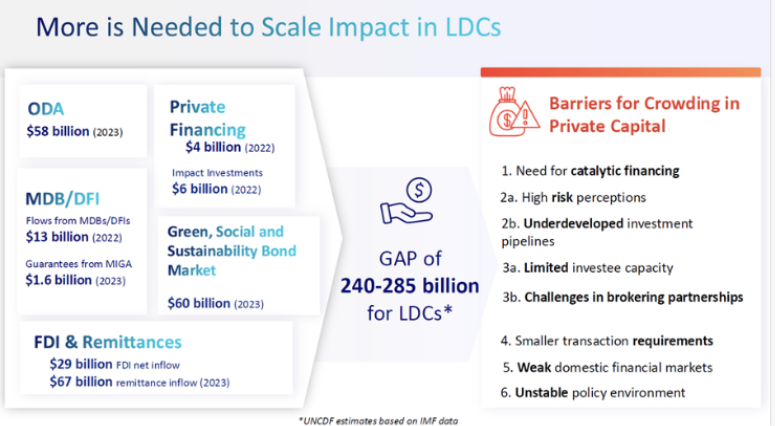
The financing landscape is rapidly changing. Financing sustainable development is no longer a question of incremental adjustment, but rather one of structural transformation. The United Nations Capital Development Fund estimates that there is a 240–285 USD billion annual funding gap for the Least Developed Countries (LDCs) to meet the Sustainable Development Goals (SDGs).
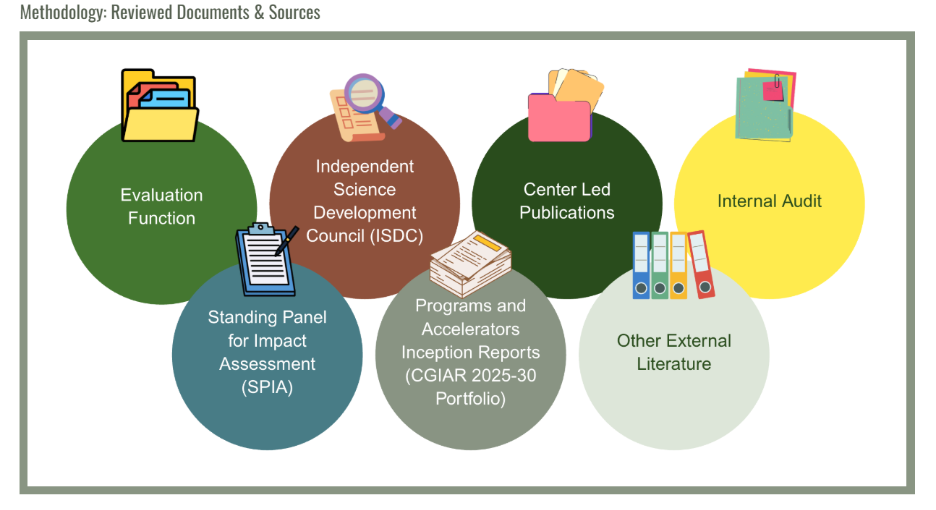
Innovative Finance (IF) is now increasingly viewed as one of the principle means to help close this investment gap. Cognizant of this gap and the challenging funding landscape, CGIAR designated IF as a ‘Way of Working’ under the 2025–30 Research and Innovation Strategy. But what does it mean in practice? How ready is CGIAR to engage with IF modalities? What can be learned from existing evaluative evidence? The Evaluation Function of the Independent Advisory and Evaluation Service (IAES) undertook a synthesis of learning to answer these questions. It was not a performance assessment, but rather a structured learning exercise through compiling and triangulating evidence from a diverse range of sources.
What does the evidence suggest?
Provide clarity of purpose. One strong finding was the need to distinguish between IF and Resource Mobilization (RM), as they have two different functions. IF can be defined as mechanisms and solutions, which increase the volume, efficiency, and effectiveness of financial flows for development. IF can take many forms and continues to evolve by instrument as well as its application to the SDGs. RM, on the other hand, may involve classic and newer ways to increase resources for CGIAR’s core mandate. These are two different functions. More work in IF may not necessarily lead to increased RM. The distinction is necessary, especially in a changing funding environment. Indeed, ambitious IF targets should be aligned with institutional frameworks and capacities, as well as clearly defined objectives.
IF ambitions require institutional investment. Evidence suggests that ambitious RM targets linked to IF require more than just technical expertise. Investments in human resources, legal and compliance capacity and administrative structures capable of navigating these systems are necessary. Such investments ensure that IF is not treated as an add-on, but rather as a strategic option pursued at scale. One participant during the IF webinar noted that:
“There are always efforts to look at seeking new financing resources, leveraging financing resources, and supporting the core work that goes on in centers, as well as across the portfolio of research programs that CGIAR implements. So, it's an ongoing effort. Often, these are fragmented efforts, but they provide great examples of what is possible.” – Andre Zandstra Global Director, Innovative Finance & Resource Mobilization, CGIAR
Findings suggest that CGIAR centers have substantial experience in country and project level financial themes, including microcredit systems, engagement with producer organizations, and development of tools aligned with CGIAR’s Impact Areas. However, achieving impact at scale through IF mechanisms can require engagement at mezzo- or macro-institutional levels (such as international financial institutions and national development banks) where financing decisions are structured and large capital flows are allocated. This shift in the level of engagement has strategic implications for positioning and capacity.
Technical assistance is both a service and an opportunity. Supporting IF through technical assistance to international financial institutions, climate funds, blended finance facilities, and de-risking mechanisms is primarily about providing expertise. In these arrangements, CGIAR contributes evidence, methodologies, and analytical tools that strengthen investment design. While this may not directly generate institutional revenue, it creates a significant opportunity to embed CGIAR’s theories of change, research findings, and technical instruments into large-scale financing platforms. Influence over design can be as consequential as direct funding flows. During the IF webinar, a System Council member noted the following:
“Most multilaterals have expertise in innovative finance. Some of these multilaterals are already funding CGIAR. I think it would be more effective to build on their work, leverage their expertise, and create a strong new portfolio for CGIAR” – Ruben Echeverria, System Council Member, CGIAR
Re-think private sector engagement regarding intellectual properties. There was consensus throughout review materials regarding CGIAR centers’ frequent collaboration with private partners. However, intellectual property remains a sensitive area. Some private actors may hesitate to engage if collaboration constrains their ability to commercialize innovations. However, in a separate review on CGIAR ventures, there were concrete examples of CGIAR centers collaborating with private entities to commercialize viable innovations. For instance, during the FRESH Initiative, CGIAR implemented pre-competitive breeding consortia where seed companies co-invested in shared research without exclusive rights. This demonstrated that open IP arrangements can stimulate collective investment, enhance innovation diffusion, and uphold equitable access. Balancing open science principles with partnership incentives should therefore not just be a legal issue, but also a strategic one. Effective engagement in IF ecosystems must account for these dynamics.
What are the implications for practice?
Evidence does not point to a single prescriptive model for engaging in IF. Instead, it highlights a set of practical considerations that can help guide action. At a strategic level, for instance, clarity is essential. IF and RM are not interchangeable concepts and treating them as such risks misaligning expectations. A more explicit articulation of how IF contributes to CGIAR’s broader funding and influences objectives would strengthen coherence. This includes identifying which IF modalities are most aligned with CGIAR’s comparative advantage, rather than pursuing broad expansion across multiple complex instruments. Strategic ambition should also be calibrated against institutional capacity. Engagement in IF can be resource-intensive, and scaling too quickly without adequate legal, financial, and administrative readiness may undermine its effectiveness.
There is a need for developing internal dashboards to help monitor climate finance and IF engagements, for enhancing transparency and strategic oversight. In addition, strengthening metrics that assess the outcomes of IF-related technical assistance and other efforts could be a win for Monitoring, Evaluation, and Learning systems. Indeed, not all engagement results in direct revenue; some outcomes relate to influence over design, leverage of external resources, or integration of CGIAR’s research into investment frameworks. Clearly distinguishing between influence, leverage, and direct RM can help improve both accountability and learning.
Finally, instead of establishing large, centralized units dedicated solely to IF, CGIAR may benefit from investing in cross-cutting competencies legal expertise, compliance knowledge, financial structuring skills, and partnership negotiation capacity that can support multiple centers and programs. A phased approach may also be advisable. Piloting selected IF modalities, assessing their feasibility and return on investment, and learning from early experiences before scaling can reduce institutional risk. There is already some ongoing work on IF spearheaded by the CGIAR Working Group on Innovative Financial Modalities, which can be amplified for greater impact.
Ultimately, the synthesis accentuates that IF is not a shortcut to RM, neither is it a peripheral experiment. It is a strategic choice that requires clarity of purpose, calibrated ambition, and deliberate institutional investment. CGIAR’s comparative advantage lies not in replicating the functions of multilateral financiers but in shaping how capital is deployed through science-based evidence, technical assistance, and partnerships that balance innovation with equitable access. The way forward therefore is a pragmatic one; investing in cross cutting institutional capabilities, piloting selectively, measuring influence as well as returns, and scaling what proves effective. If approached strategically, IF can move from fragmented efforts to a coherent system-level approach aligned with CGIAR’s 2025 – 30 Research and Innovation Strategy:
“Just as when we moved from the Millennium Development Goals to the Sustainable Development Goals, the question now is what will shape the global agenda beyond 2030. CGIAR can help define this vision through science-based evidence and innovation.” – Anna Okello, Director Food Frontiers and Security Science Program
Related resources
Visit the Ways of Working resource hub to learn more about the synthesis of evidence about CGIAR Ways of Working. The hub brings together IAES Evaluation Function reports, syntheses, briefs, and a video sharing stakeholder insight on advancing the Ways of Working across CGIAR.


